
Reviewed · COOKING CLASSES
Master Class – Uzbek Bread (Khiva)
The most enjoyable part of this Khiva activity is that you do not just look at Uzbek food, you help make it. You shape your own bread, press in flower ornaments, hang it in the bread maker, then eat the finished loaf.
I like the short 45-minute format, which fits neatly between visits to Khiva’s monuments. I also like that this is a private activity, so your group can take part without strangers crowding the work area. The main drawback is clear: at $15, the class needs good explanation and guidance to feel like more than expensive bread.
Key points at a glance
- Shape and decorate your own Uzbek bread: You take part in the work instead of watching a demonstration.
- Bake in a very hot bread maker: Protective clothing is provided before you handle the baking stage.
- Eat what you make: Your finished bread is included, along with tea.
- Held at Tea House Mirza Boshi: The activity starts and ends at the same meeting point in Khiva.
- Private and brief: Only your group participates, and the session lasts about 45 minutes.
- Good value only with useful instruction: The hands-on work is appealing, but the experience depends heavily on how much the team explains.
Making bread inside Khiva’s old city
Khiva is famous for grand walls, tiled buildings, minarets, and old streets. After a few hours of looking up at monuments, a food activity gives you something different to do with your hands.
This class centers on traditional Uzbek bread. You are not simply served a loaf with a meal. You prepare the dough, work on its decoration, and take part in the baking process. That simple change matters. Bread becomes something you make and understand, not just another item on a restaurant table.
The activity takes place at Tea House Mirza Boshi in Khiva, in the Xorazm Region of Uzbekistan. Since the meeting point is also the ending point, you do not need to arrange a separate ride to another part of town. That makes the class easy to fit into a day of sightseeing.
The setting also gives the experience a practical connection to food service. One person who took the class found it interesting to see some of the bread they had helped make later being served to customers at the restaurant. You may find that especially satisfying if you like seeing how a kitchen works beyond the dining room.
More Cooking Classes in Khiva:
- Traditional Khiva Cooking Class with Market Visit & Lunch
★ 5.0 · 4 reviews - Samarkand: Village Tour with Plov Cooking Class & Home Visit
★ 5.0 · 29 reviews - Samarkand: Uzbek Cooking Class in a Village Home
★ 5.0 · 22 reviews
What happens during the 45-minute class
The class is short, so expect a focused activity rather than a long cooking course. The available details describe a professional team helping you through the process, but they do not name individual guides or give a minute-by-minute schedule.
The work begins with preparing the traditional Uzbek bread. You take part in forming it, rather than leaving the full job to the staff. This is the central reason to book. If you want a long lesson on flour, yeast, ovens, and regional food customs, you should keep your expectations in check and ask the team questions during the session.
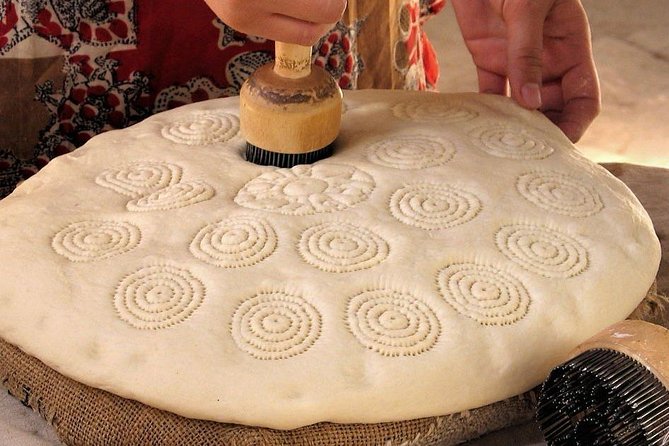
Next comes the decoration. You fill flower ornaments into the bread, creating a pattern before it goes into the heat. This is a small detail, but it gives you a personal mark to look for when the bread is finished. It also makes the class more suitable for families and anyone who enjoys a creative task alongside sightseeing.
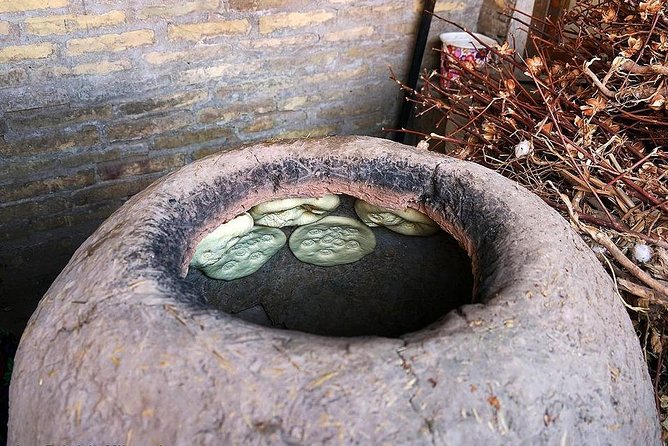
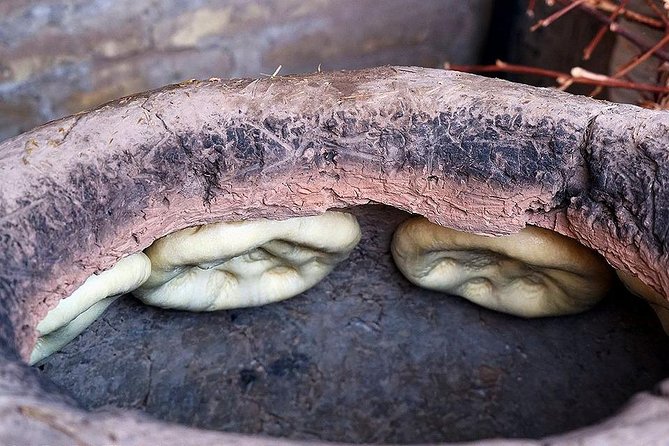
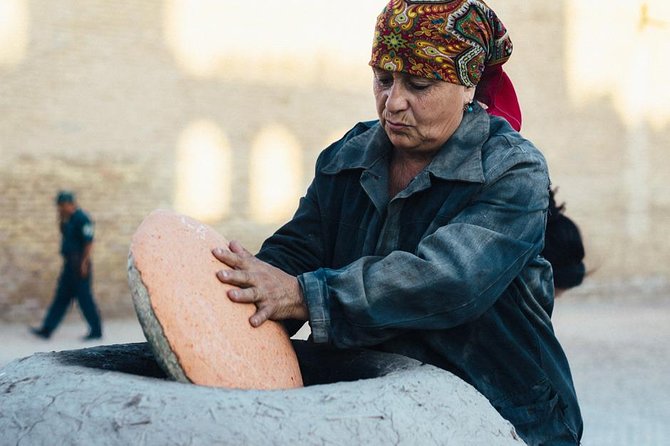
The final work stage involves hanging the bread in the bread maker. The description emphasizes that the heat is high, so you put on special clothing first. It refers to these as clothes of tankers, which appears to mean protective clothing for the hot baking area. You should follow the team’s instructions carefully and let them handle any step that feels too close to the heat.
Once baking is complete, you eat the bread you prepared. Tea is included as well. This gives the activity a clear ending: prepare, decorate, bake, and taste. There is no need to wonder what happens to your loaf or whether food is part of the price.
Why the hands-on work is the main attraction
The best reason to choose this class is participation. Khiva can become a place of repeated visual stops: another facade, another courtyard, another tiled tower. A bread class breaks that rhythm with a task that uses touch, smell, timing, and taste.
I like that the class gives you a small connection to everyday food rather than only the grand architecture of the city. Bread is a familiar food, but the local preparation and decoration give it a distinctly Uzbek setting. You leave with a better sense of how a simple staple can also carry craft and ceremony.
The decoration step is especially useful for children and groups with mixed interests. Someone who is not excited by another historical building may enjoy pressing patterns into dough. The session is also brief enough that younger participants may not have time to lose interest.
There is a limit, though. The published details do not promise a long talk about bread, its history, the ingredients, or regional differences. One disappointing experience came from receiving too little explanation and feeling that the price paid for bread rather than a class. If cultural background is important to you, ask questions as you work and make sure the team is prepared to explain the process.
Tea, equipment, and the bread you make
The $15 price includes tea, use of baking equipment, and the bread you make. These inclusions are straightforward, but they help you judge the real cost.
You do not need to bring baking tools. The equipment is supplied, and the team helps you use it. That is useful for a short holiday activity, since carrying flour, utensils, or protective clothing around Khiva would be impractical.
The bread itself is also included, so the food is not an extra purchase at the end. The value depends on how much instruction comes with it. If the staff guide you closely, explain what you are doing, and help you produce a loaf you can enjoy, $15 is a fair price for a private cultural activity. If the session offers little talk and very little personal work, the same price may feel high.
Tea adds a pleasant pause, but it should not be treated as the main reason to book. You are paying for the making process and the private format, with tea and bread as part of the package.
Other personal expenses are not included. The activity data does not list any required extras, so you should simply remember that anything outside the stated program is your responsibility.
More things to do in Khiva:
- Khiva: Historical City Highlights Guided Walking Tour
★ 4.8 · 156 reviews - Transfer: Bukhara – Khiva via Ancient Fortresses
★ 4.5 · 101 reviews - Daytrip From Khiva To Ancient Fortresses
★ 4.6 · 60 reviews - Daytrip from Khiva to Aral Sea Cemetery of Ships. All in one
★ 4.3 · 52 reviews
A private class, not a large cooking show
Only your group takes part. That is one of the strongest practical features of the booking.
A private session can make the class easier to follow because the team can focus on your group’s pace. You may have more room to shape the dough, ask questions, and watch the hot baking stage. It also avoids the common problem of standing behind a crowd and seeing only the final result.
The private format does not automatically guarantee a detailed lesson. The quality of the experience still rests on how actively the professional team teaches. The information does not provide guide names, group-size limits beyond the private arrangement, or a promise of a formal history talk.
For that reason, I would book this as a small, practical activity rather than as a full cooking school course. If you want personal attention while making a single traditional food, the format fits. If you prefer a broad food tour with several dishes and a long discussion, this is too narrow and too short.
Is $15 good value in Khiva?
At $15 per person, this is not a major expense for most visitors, but it is enough to deserve a close look. The class lasts about 45 minutes, includes tea and your bread, and is private. Those details give it more value than simply buying bread at a restaurant.
The short duration works in its favor. You can place the activity between sightseeing visits without giving up half a day. It also makes the class a good choice when you want one extra cultural activity but do not want another lengthy tour.
The private format works in its favor too. You are paying for a shared experience with only your group, not joining a large public demonstration. That can be useful for families, couples, and friends who want to work at their own pace.
The weak point is the amount of teaching. The class is worthwhile when the team explains the bread and helps you through each step. It is less worthwhile when you mainly receive bread and limited context. If the team gives only brief directions, you may feel you could have bought a similar loaf for less.
My practical advice is to decide what you want before booking. For a quick, hands-on activity with food at the end, $15 is reasonable. For a serious lesson in Uzbek baking traditions, the description does not promise enough to support that expectation.
How it fits into a day in Khiva
Start and finish at Tea House Mirza Boshi. Since the activity returns to its meeting point, you can continue sightseeing from there after the bread is ready.
The session is listed as approximately 45 minutes. Allow a little flexibility around that time for meeting the team, getting into the protective clothing, and finishing the tea and bread. The actual class may be short, but you should not schedule another appointment so tightly that a few extra minutes cause trouble.
Booking is usually made around nine days ahead of the activity date. That is useful as a planning guide, especially if your Khiva visit is tightly organized, though it does not guarantee availability. The ticket is mobile, so you can keep the booking on your phone rather than needing a printed voucher.
Confirmation is provided when you book. The activity is available as a private booking, and the supplied details do not mention transport from hotels or any other meeting location. Plan to reach Tea House Mirza Boshi on your own unless your booking confirmation gives you different instructions.
The cancellation policy is friendly but firm. You receive a full refund if you cancel at least 24 hours before the start time. Cancellations or changes made within 24 hours are not accepted for a refund, and the cut-off follows local time in Uzbekistan.
Who will enjoy this bread class most?
I would recommend it first to visitors who want a break from monument viewing. The class gives you something practical and social to do, and it can refresh a day spent walking through Khiva.
It also suits:
- Families, because shaping and decorating dough is easier to enjoy than a long lecture.
- Couples and friends, because the private format lets you share the task without a large group.
- Food-focused visitors, especially those who want to eat something they helped prepare.
- Short-stay visitors, because 45 minutes is easy to fit into a packed schedule.
- People who enjoy local crafts, since the flower decoration adds a personal touch.
I would be more cautious if you want detailed culinary instruction. The class may provide that through the team, but it is not guaranteed by the published description. One account found the experience too expensive because there was little explanation about the bread or its background.
The activity is also not a full meal. Tea and bread are included, but other personal expenses are not. Treat it as a snack-sized cultural class, not a replacement for lunch or dinner.
What makes the experience memorable
The strongest moment is likely to be seeing your decorated bread go into the heat and come back ready to eat. That simple sequence gives the class a clear story, and you can connect the finished food to your own work.
I also like the chance to see bread being made in a functioning tea house setting. If some of the bread is later served to customers, the class feels connected to a working kitchen instead of being an isolated tourist demonstration.
The protective clothing is another unusual detail. The heat is serious enough that you are asked to wear special clothing before handling the baking stage. That makes the process feel more physical and gives you a better sense of the work involved.
Still, the experience needs a good human touch. The bread, tea, and equipment are fixed parts of the package. The explanation is where the class can become either a useful cultural lesson or a very brief baking stop. Ask about the bread as you go: what makes it traditional, how the decoration is made, and what happens in the bread maker. Those questions can help you get more from the 45 minutes.
Should you book the Uzbek Bread Master Class?
Book it if you want a short private activity that lets you make, decorate, bake, and eat a traditional Uzbek bread in Khiva. The $15 price is reasonable when you value the hands-on work, tea, private setting, and finished loaf.
I would skip it if you want a detailed food history lesson or a broad cooking course. The session is brief, and the amount of explanation may be limited. For the best chance of a satisfying experience, arrive ready to participate and ask questions rather than waiting for a long presentation.
For most visitors, this works best as a pleasant change of pace during a Khiva sightseeing day. It is not an essential major tour, but it can add a personal food memory to a city known mainly for its monuments.
FAQ
Where does the Uzbek bread class start?
The activity starts at Tea House Mirza Boshi in Khiva, Xorazm Region, Uzbekistan.
Where does the activity end?
It ends back at the meeting point, Tea House Mirza Boshi.
How long does the bread class last?
The activity lasts approximately 45 minutes.
How much does the experience cost?
The listed price is $15 per person.
Is this a private activity?
Yes. Only your group participates.
What is included in the price?
Tea, use of baking equipment, and the bread you make are included.
Do I take part in baking the bread?
Yes. You prepare the bread, add flower ornaments, take part in the baking process, and hang the bread in the bread maker with help from the team.
Can I cancel for a full refund?
Yes. You can receive a full refund if you cancel at least 24 hours before the experience start time. Cancellations or changes made less than 24 hours before the start time are not refunded or accepted.
Just added around Khiva
- Uzbekistan 6 Days Private Tour Khiva-Bukhara-Samarkand by Train★ 5.0 · 4 reviews
- Traditional Khiva Cooking Class with Market Visit & Lunch★ 5.0 · 4 reviews
- 6- Day Private Tour to Tashkent, Khiva, Bukhara and Samarkand★ 5.0 · 5 reviews
- Old Khiva Stories with Your Local Guide★ 5.0 · 5 reviews
- A Night In The Kyzylkum Desert [2] From Khiva★ 4.5 · 3 reviews
- Khorezm Fortress and KyzylKum Desert Private Tour★ 5.0 · 3 reviews
- Best of Khiva: Exclusive Private Tour!★ 5.0 · 3 reviews
- Khiva: Historical City Highlights Guided Walking Tour★ 4.8 · 156 reviews
Cooking Classes, compared.
Village Tour with Plov Cooking Class & Home Visit
Read our review →
Cooking class in Samarkand with local life experience
Read our review →
cooking traditional food in Samarkand with local people
Read our review →
Private Samarkand Cooking Class with Market Tour & Transfers
Read our review →
Cooking Class in the Village with Local Family in Samarkand
Read our review →
Browse the lists this tour appears in