Reviewed · TRAIN EXPERIENCES
Uzbekistan 6 Days Private Tour Khiva-Bukhara-Samarkand by Train
Khiva’s walled old town, Bukhara’s shaded pools and trading domes, and Samarkand’s vast Registan square make this six-day private tour a strong first look at Uzbekistan. You move between the three major Silk Road cities by train, with local guides and drivers handling the practical work.
I like the central boutique or three-star hotels, which save you long daily transfers, and I like that entrance fees, breakfasts, train tickets, and airport transfers are already included. The main drawback is the pace: two train journeys and a full day of sightseeing leave little room for slow wandering.
Key points at a glance
- Three historic cities in six days: Khiva, Bukhara, and Samarkand form a clear west-to-east route through Uzbekistan.
- Khiva begins right after arrival: Your driver meets you at Urgench Airport before taking you to the walled Itchan Kala.
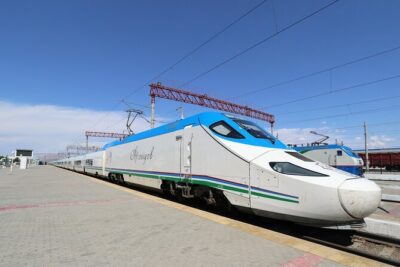
- Train travel is built into the price: You travel from Khiva to Bukhara, then from Bukhara to Samarkand, subject to train availability.
- Private touring keeps the schedule flexible: You can request changes at no or small extra cost, including a desert or mountain detour.
- The sightseeing is architecture-heavy: Expect citadels, mosques, minarets, madrassas, mausoleums, and observatory ruins.
- The best value comes from the inclusions: Five nights, guides, transport, museum tickets, breakfasts, and customer support are covered in the $800 price.
Why this route works so well
This tour follows Uzbekistan’s most useful first-time itinerary. You start in Urgench, reach Khiva almost at once, then continue by train to Bukhara and Samarkand. That saves you from arranging separate domestic transfers across a large country.
The route also builds nicely. Khiva gives you a compact walled city where monuments sit close together. Bukhara spreads the history across old squares, markets, mosques, and royal buildings. Samarkand finishes with the country’s biggest architectural set pieces.
At $800 per person, the price is not just paying for sightseeing. It covers five nights in centrally located hotels, five breakfasts, private air-conditioned transport, guides in each city, entrance tickets, train tickets, airport transfers, and all listed taxes. You still pay a single-room supplement of $25 per night, along with small cash charges for photography or video in some museums.
That package is useful if you value a fixed plan. You do not need to sort out three hotels, several entrance counters, train reservations, and city transfers on your own. The tradeoff is that you have less control over the exact departure times, especially since the Khiva to Bukhara train may leave at 3:00 or 6:00 depending on the date.
More Multi-Day Tours in Bukhara
- 2 Days Tour to Bukhara and Samarkand from Tashkent by train
★ 5.0 · 53 reviews - Uzbekistan 8 Days Private Tour Tashkent-Urgench-Bukhara-Samarkand-Tashkent
★ 4.5 · 38 reviews - Uzbekistan in 7 days Tashkent, Samarkand, Bukhara and Khiva
★ 5.0 · 10 reviews
Day 1: Khiva’s walls and royal palaces
Your tour starts at Urgench Airport. A driver meets you in the arrival hall with a name sign, then takes you to Khiva and the Itchan Kala, the old inner town.
Itchan Kala covers about 26 hectares and is enclosed by brick walls reaching up to 10 meters high. It is the kind of place where the setting does much of the work. Once inside, you are surrounded by narrow lanes, tiled façades, domes, and former residences of khans, officials, merchants, and religious leaders.
The Kalta Minor Minaret is an early highlight. Its unusual shape comes from an unfinished plan. Mohammed Amin Khan intended it to rise more than 70 meters, but construction stopped at 29 meters. The entire lower structure is covered with glazed tile and majolica, giving it a very different look from the tall, slender minarets elsewhere in Uzbekistan.
Allow two hours for the Kunya Ark, Khiva’s fortified citadel. The complex sits against the western wall of Itchan Kala and was the seat of the khan. It is large enough to give you a sense of a town inside the town, with royal spaces and defensive structures gathered in one compound.
The Pakhlavan Makhmud Mausoleum adds a more personal side to Khiva. Pakhlavan Makhmud was known as a poet, philosopher, strongman, and healer. The original building grew into a pilgrimage complex with a mosque and khanaka, and its large blue-tiled dome is one of the city’s most recognizable features.
At the Juma Mosque, look up at the wooden columns supporting the roof. The mosque sits near the center of the old city, where the khan’s name was once read during Friday prayers. It is a welcome change from the grand tiled façades because its atmosphere comes from shade, timber, and repetition.
The Tash Khauli Palace shows the more formal side of Khorezm architecture. Built between 1830 and 1838 for Allakuli Khan, it occupies the eastern part of Itchan Kala. The final stop, the Islam Khodja Complex, combines a madrassa and minaret and gives you another strong view of the city’s decorated brick and tile work.
This is a full first day. You cover many monuments, and the guide is useful because the buildings can begin to blur together without context. Wear practical shoes and keep some energy for simply walking the lanes after the formal touring ends.
Day 2: A final look at Khiva, then the train east
The second morning gives you four hours in Itchan Kala. That extra time matters. You can revisit a favorite courtyard, enter monuments that deserve a slower look, or browse local crafts without trying to fit everything into one guided circuit.
Later, you transfer to Khiva railway station for the train to Bukhara. The departure may be at 3:00 or 6:00, depending on the day. The listed transfer time is six hours, so this is not a quick hop. It is the least sightseeing-heavy part of the tour, but it also gives your legs a break after Khiva’s walking schedule.
The train ticket is included, and a driver meets you at Bukhara station for the short transfer to your hotel. Since the exact train schedule depends on availability, confirm the departure time before finalizing any independent plans.
Day 3: Bukhara around Lyab-i-Hauz
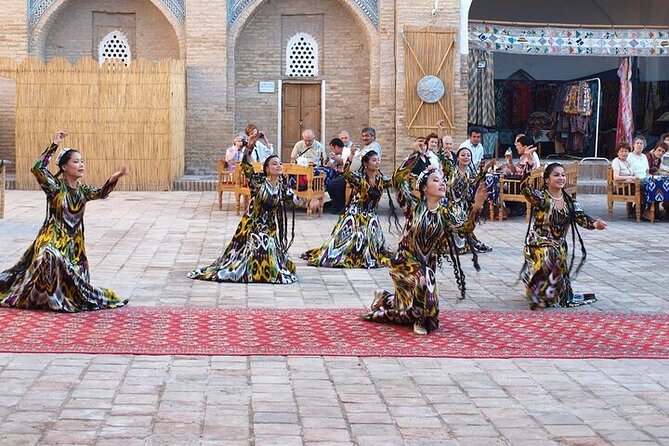
Bukhara feels less enclosed than Khiva, but its old center is still compact enough to explore on foot between guided stops. The day begins at Lyab-i-Hauz, a square built around a historic water reservoir.
The ensemble includes the Nadir Divan Begi Madrassa, a khanaka, a caravanserai, and the pool itself. It was created in the 16th and 17th centuries and remains one of Bukhara’s natural rest points. The water, trees, and surrounding buildings create a pause in a schedule otherwise packed with architecture.
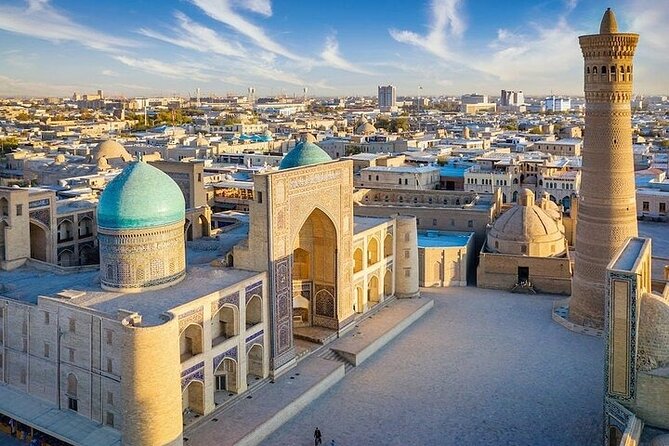
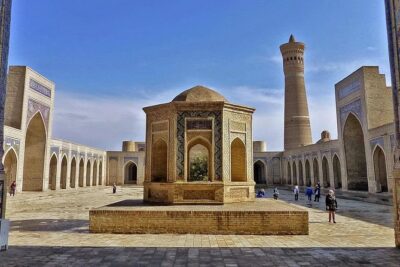
At the Kalyan Minaret, you see one of Bukhara’s defining monuments. Built in 1127, the minaret reaches 45.6 meters and survived the Mongol conquest. The nearby Friday Mosque and Mir-i-Arab Madrassa complete the Po-i-Kalyan setting, giving you one of the strongest architectural views of the trip.
The Ark of Bukhara is less delicate but just as important. This fortified royal town housed Bukhara’s rulers for more than a thousand years. Its age is difficult to pin down, but the fortress was the center around which the medieval city developed.
Across from the Ark, the Bolo Hauz Mosque is known for its wooden columns and its position beside an octagonal pool. It was begun in 1712 and is one of the last major premodern buildings in Bukhara.
The Maghak-i Attari Mosque brings an older religious layer into view. It is described as the oldest surviving mosque in Central Asia and was built on a site associated with earlier Buddhist and Zoroastrian worship. Its brickwork rewards a close look.
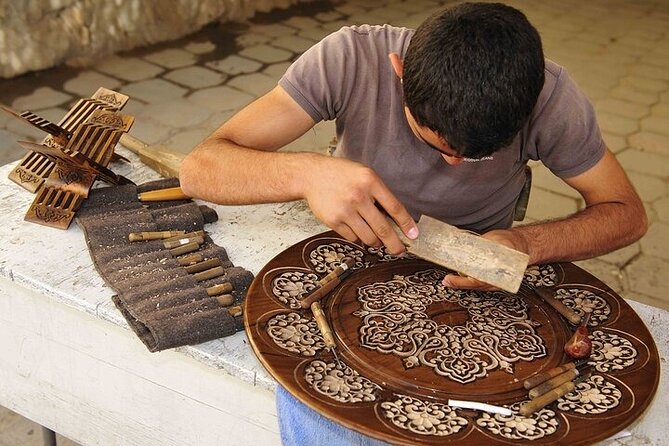
The day ends at the Trading Domes, a medieval bazaar area with artisan workshops. This is a good place to slow down, browse, and buy something small if you want a practical souvenir. The schedule gives you a broad look at Bukhara, but you may want to return to Lyab-i-Hauz or the trading streets during your free time.
More Multi-Day Tours in Samarkand
- Yurt stay and Hiking in the Nurata Mountains tour – 2 days
★ 5.0 · 35 reviews - 2 Days of Tour in Yurt Camp and Aydarkul
★ 5.0 · 15 reviews - Kyzylkum Desert tour from Samarkand (1Night 2 Days)
★ 4.3 · 7 reviews - Two Days in Fann Mountains at Iskandarkul and Sevenlake
★ 5.0 · 6 reviews
Day 4: Free time, then Samarkand by train
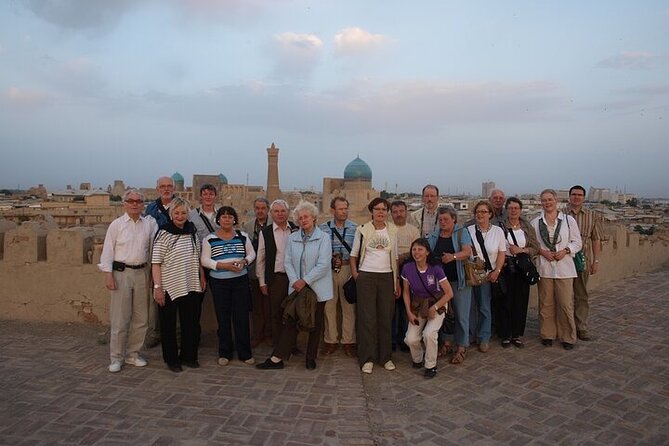
You get four hours at leisure in Bukhara before transferring 15 kilometers to Kagan railway station. That free block is valuable because Bukhara has more monuments than can comfortably fit into one guided day.
You could use the time to revisit a museum, sit near Lyab-i-Hauz, explore the old market streets, or simply take a slower walk. The tour is customizable, so this is also the day when a requested adjustment may make the most sense.
The train to Samarkand is subject to availability. After arrival, a short transfer takes you to your central hotel. The plan keeps the city changes efficient, but it also means you should not count on a long evening for independent sightseeing.
Day 5: Samarkand’s grandest monuments
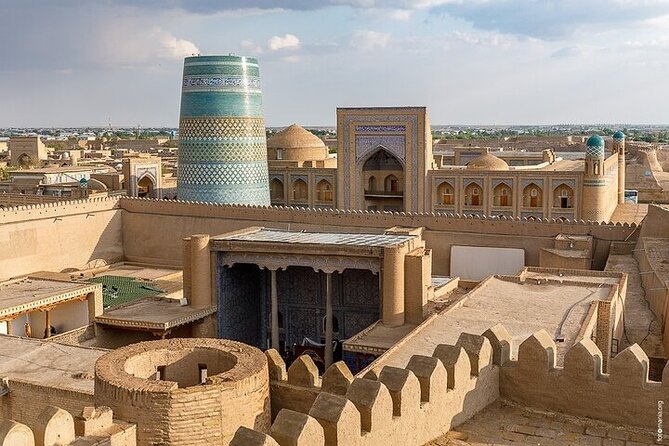
Samarkand gets the longest sightseeing day, and the order makes sense. You begin at the Gur Emir Mausoleum, the resting place of Timur. The building dates to 1404 and 1405, with later restoration shaping much of what you see now. Inside, you can view the famous jade stone associated with Timur’s tomb.
The Registan is the visual climax. Three madrassas, Ulugh Beg, Sher-Dor, and Tilla-Kari, frame the square. The site became Samarkand’s main city square after life shifted away from ancient Afrosiab. Give yourself time here. The scale can be hard to take in during a rushed visit, and the tile patterns deserve a closer look.
The Bibi Khanym Mosque was built between 1399 and 1404 on Timur’s order after his campaign in Delhi. It was intended to be one of the great structures of the region, including a very tall minaret. The mosque is close to the Siab Bazaar, so the two stops work well together.
Siab Bazaar gives you a change of pace. Its produce and handicrafts provide a direct look at everyday commerce in Samarkand. You have only about 30 minutes here, so treat it as a quick taste rather than a full market visit.
The Shah-i-Zinda complex is more intimate than the Registan. It contains more than 20 mausoleums and 44 tombs on the southeastern mound of Afrosiab. The tiled passage is one of Samarkand’s most memorable walks, but the steps and uneven surfaces mean you should move at a comfortable pace.
You finish at the Ulugh Beg Observatory, where only part of the original structure remains. Ulugh Beg, Timur’s grandson, was an astronomer and scientist as well as a ruler. The surviving section of his enormous sextant shows the serious scale of the work, even though the observatory itself is now mostly foundations.
This is a demanding day. You see the essential Samarkand monuments, but you will probably want water, comfortable shoes, and a little patience with the schedule. The advantage of a private tour is that your guide and driver can keep the transitions organized.
Hotels, transport, and the value of private touring

The hotels are described as highly rated three-star or boutique properties in central locations. That is more important than a luxury label here. A central hotel lets you spend free time near the old city instead of losing it in long transfers.
The air-conditioned vehicle is used for airport pickups, station transfers, and city touring. The rail legs break up the longer overland distances and offer a more practical way to connect the route than arranging separate private drives.
Each city has its own licensed local guide. That matters in Uzbekistan because the buildings often combine royal, Islamic, scholarly, and commercial functions. A local guide can give each site its place in the larger story instead of treating every blue-tiled building as another photo stop.
The package also includes 24-hour customer service and visa support if your nationality does not qualify for a waiver. You must still check the visa rules for your passport and obtain the required visa online or through an Uzbek embassy.
A printed itinerary is useful on a multi-city trip like this. The tour can also be adjusted, and an earlier booking account included an added Tashkent extension with organized connections between all cities. Do not assume that extra city is part of this six-day price, but it shows the route can be expanded by request.
Small costs and practical limits
Museum photography and video charges are not included. Expect to pay about $1 to $2 per museum in cash when required. Tips for guides and drivers are also separate and appreciated for good service.
The single-room supplement is $25 per night, or $125 for five nights. For solo travelers, add that amount to the advertised per-person price when comparing options.
The cancellation terms are strict close to departure. You receive a full refund if you cancel at least three full days before the start time. Changes or cancellations inside that window are not accepted or refunded.
Most people can participate, and the tour is private, meaning only your group takes part. That makes it a better fit than a fixed coach tour if you want to request small timing changes or add a side trip.
Who should book this Uzbekistan tour?
I would choose this tour if you want to see Uzbekistan’s three headline cities without planning every train, hotel, guide, and transfer yourself. It suits first-time visitors who prefer a clear route and want history explained on site.
It is also a good choice for couples, families, or small groups who value a private vehicle and flexible arrangements. The group discount may improve the price for several people traveling together.
I would be more cautious if you prefer slow travel. The itinerary is full, and the train days limit your control over the timetable. You can make the trip more relaxed by asking for fewer stops, more free time, or a longer stay in one city.
Final booking advice
Book this tour if the $800 price fits your budget and you want a well-organized introduction to Khiva, Bukhara, and Samarkand. The strongest value comes from the combination of central hotels, included rail tickets, city guides, entrance fees, breakfasts, and private transfers.
Before paying, confirm your train departure times, hotel names, visa requirements, and any requested desert, mountain, or Tashkent extension. If you are happy with an active six-day schedule, this route gives you the essential monuments with very little logistical guesswork.
FAQ
Where does the tour start?
The tour starts at Urgench Airport in Uzbekistan. A driver meets you in the arrival hall with a name sign and transfers you to Khiva.
How many nights of accommodation are included?
Five nights are included in central, highly rated three-star or boutique hotels. A single-room supplement of $25 per night applies if you want a private room.
Are train tickets included?
Yes. Train tickets for the Khiva to Bukhara and Bukhara to Samarkand journeys are included, subject to availability.
Are entrance fees included?
Yes. Entrance tickets to the listed museums and attractions are included. Photography and video charges at some museums, usually $1 to $2, are paid separately in cash.
Is this a private tour?
Yes. Only your group participates in the tour. The itinerary can be customized at no or small extra charge, and desert or mountain detours can be added.
What is included in the $800 price?
The price includes listed taxes, air-conditioned transport, five hotel nights, local licensed guides, visa support where needed, attraction entrance tickets, train tickets, five breakfasts, and 24-hour customer service. Tips and the single-room supplement are not included.
More Private Tours in Khiva
- Uzbekistan 6 days private tour Tas-Khiva-Buk-Sam-Tas
★ 5.0 · 45 reviews - Private Daytrip to 7 Ancient Fortresses of Khorezm
★ 5.0 · 25 reviews - Best of Khiva: Exclusive Private Tour!
★ 5.0 · 9 reviews - Private Bukhara-Khiva Transfer via Ancient Fortresses
★ 4.5 · 8 reviews
More Private Tours in Bukhara
- Uzbekistan 3 Day Private Tour Tashkent-Bukhara-Samarkand Bullet Train
★ 4.5 · 23 reviews - 6- Day Private Tour to Tashkent, Khiva, Bukhara and Samarkand
★ 5.0 · 5 reviews - Best of Bukhara: All Day Private Old Town Tour
★ 5.0 · 66 reviews - Best of Bukhara: All Day Private Old Town Tour
★ 4.9 · 62 reviews
Just added around Samarkand
- Private Intercity Transfer Tashkent – Samarkand – Tashkent★ 3.5 · 3 reviews
- Tashkent-Samarkand-Bukhara tour-3nights/4 days★ 5.0 · 5 reviews
- 6- Day Private Tour to Tashkent, Khiva, Bukhara and Samarkand★ 5.0 · 5 reviews
- The Golden City of Samarkand: A Self-Guided Audio Tour★ 4.0 · 4 reviews
- Samarkand Capital of Amir Timur Private Tour with Transport★ 5.0 · 3 reviews
- Seven Lakes Panjakent: One-Day Adventure from Samarkand★ 5.0 · 3 reviews
- Shakhrisabz Private Day Tour from Samarkand★ 5.0 · 4 reviews
- Tadjikistan 7 Lakes Day Trip from Samarkand with Lunch★ 5.0 · 5 reviews
Train Experiences, compared.
2 Days Tour to Bukhara and Samarkand from Tashkent by train
Read our review →
Uzbekistan 3 Day Private Tour Tashkent-Bukhara-Samarkand Bullet Train
Read our review →
Afrosiyob high speed train tickets – Guaranteed Pass
Read our review →