
Reviewed · CITY TOURS
The Golden City of Samarkand: A Self-Guided Audio Tour
Samarkand’s greatest sights come with stories that are easy to miss when you explore alone. This GPS-guided audio walk links Shah-i-Zinda, Siab Bazaar, Bibi Khanym Mosque, and the Registan with facts, folklore, and local color from an award-winning Central Asia author.
I like the low price and the freedom to stop when you want. I also like the offline maps and audio, which matter in a city where you may not want to depend on mobile data. The catch is that the app can feel a little fiddly at the start, especially when you are trying to reach the exact opening point and learn how to pause and resume the recording.
Key points at a glance
- Five major Samarkand stops: The route covers Shah-i-Zinda, Siab Bazaar, Bibi Khanym Mosque, the Registan, and Sher Dor Madrassa.
- GPS-triggered storytelling: Recordings are tied to locations, so the audio is meant to begin as you reach each point.
- Offline access: Download the audio, maps, and geo-data before setting out.
- About one hour: This is a compact introduction, not a full-day city tour.
- Local flavor: The route points you toward chaikhanas, or Uzbek teahouses, as well as famous monuments.
- Bring your own phone: The smartphone, transport, food, and attraction tickets are not included.
Why this short Samarkand walk works
Samarkand can feel like a grand open-air history book. Huge blue domes, tiled facades, old trading routes, and sacred mausoleums crowd into a relatively compact sightseeing area. The challenge is knowing what you are looking at and why it matters.
This tour gives you a narrative thread. Instead of simply walking from one photogenic building to the next, you hear about the people, beliefs, rivalries, and odd details behind the monuments. The tone is not limited to dates and rulers. It also brings in pilgrim customs, local food stops, and the practical texture of daily life.
The route takes about an hour, though your actual visit will last longer if you stop for photos, explore the sites, browse the bazaar, or sit for tea. The recordings are not a live guide waiting for you at each corner. You control the pace, and that is both the main benefit and the main limitation.
I would treat it as a structured introduction to central Samarkand. It helps you get your bearings and gives the major sights a voice, but it does not replace entrance tickets, a museum visit, or a longer guided tour with time for questions.
More City Tours in Samarkand
- Private Samarkand City Tour With Transportation
★ 5.0 · 149 reviews - A City Tour Of Samarkand: The Pearl Of The East
★ 5.0 · 133 reviews - Private Guided Tour Samarkand city history and culture
★ 5.0 · 22 reviews
Starting at Shah-i-Zinda’s sacred doorway
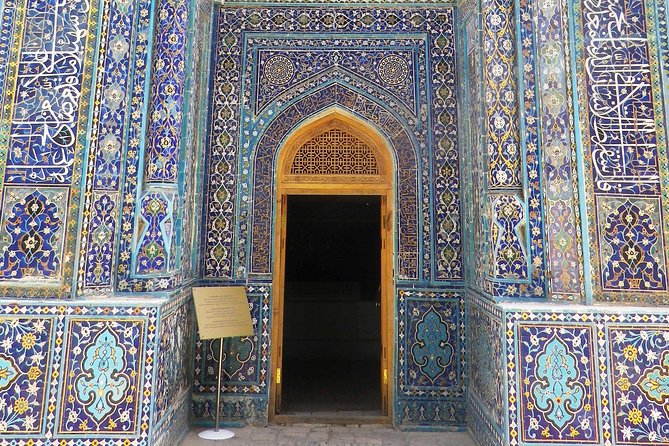
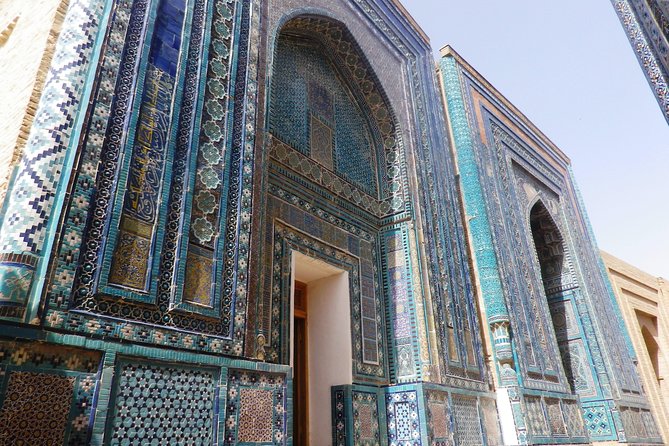
The tour begins on Shah-i-Zinda Street, at the Shah-i-Zinda complex. This is a strong starting point because the site introduces the religious side of Samarkand before the route moves toward markets and imperial monuments.
Shah-i-Zinda originally dates from the ninth century. The complex is made up of mausoleums, many with dazzling tilework, but the audio focuses on more than decoration. You learn about the small doorways built so that visitors must bow to Allah as they enter. That simple architectural detail turns an ordinary entrance into a physical act of respect.
The complex also contains plain white graves covered with gifts left by pilgrims. This contrast is useful: grand tiled buildings share space with simple burial places and living religious customs. You get a better sense of Shah-i-Zinda as a place of devotion, not only as a historic photo stop.
Give yourself time here. The audio is approximately one hour overall, but Shah-i-Zinda alone may tempt you to pause and look closely. If you rush through the complex to keep up with the recording, you will miss part of its quiet power.
The GPS format should help you move through the area without constantly checking a written guide. Still, the starting point matters. Set up the app before you arrive, confirm that the offline material is downloaded, and allow a little time to reach the exact place where the first recording begins.
Siab Bazaar and the everyday side of Samarkand
From the solemn setting of Shah-i-Zinda, the route turns toward Siab Bazaar. This change is one of the tour’s best features. Samarkand is not only domes and dynasties. It is also a working city where people shop, sell, eat, and meet.
Siab Bazaar is covered by a large two-tiered corrugated roof, with extra traders gathered under sun-faded shelters, gazebos, and parasols. The description is not polished or postcard-perfect, and that is the point. You get a picture of a real market with a wide range of goods and plenty to examine at your own speed.
The audio helps you notice the bazaar as more than a place to pass through on the way to Bibi Khanym Mosque. You might find local foods, household goods, and other everyday items, though the exact stalls and offerings can change. The tour also draws attention to chaikhanas, traditional Uzbek teahouses, where you can take a break if one suits your route.
This stop adds welcome variety. Monument fatigue is real, especially in a city where every few minutes can bring another enormous facade. A market gives your eyes a rest and lets you see how the city functions beyond its celebrated buildings.
Keep your phone volume at a level that lets you hear the recording without shutting out your surroundings. Markets are places where you need to watch where you are going, and an audio tour is best treated as a guide you can pause, not a command you must follow every second.
Bibi Khanym Mosque and Timur’s ambition

The Bibi Khanym Mosque brings you back to imperial Samarkand. Timur commissioned it after his campaign in India in 1399, using treasures taken from the subcontinent to fund its construction.
The story is not a simple celebration of architectural achievement. Timur reportedly ignored his architect’s advice and insisted on a very specific design. That detail gives the monument a human edge. It shows how rulers can shape buildings through force of personality, even when their building plans create serious practical problems.
The mosque is one of the places where scale matters. You do not need a long lecture to understand that the project was meant to signal power. The audio gives you the political background, while the building itself supplies the visual impact.
This is also a stop where you should check what is included before you arrive. The audio tour does not cover entrance fees to museums or other attractions along the route. You receive the story and directions, but admission costs are your responsibility.
Because the tour is self-guided, you can linger at Bibi Khanym without holding up a group. Pause the recording, look at the structure from different angles, and restart when you are ready. That flexibility is worth more than it may sound, especially at a site where the scale is difficult to absorb in one quick glance.
More Guided Tours in Samarkand
- Samarkand: Historical Monuments Guided Walking Tour
★ 4.8 · 446 reviews - Samarkand: Shahrisabz Day Trip with Optional Local Guide
★ 4.9 · 81 reviews - Guide / excursion service in Samarkand
★ 5.0 · 57 reviews - Samarkand Historical City Highlights Guided Walking Tour
★ 5.0 · 22 reviews
The Registan, Samarkand’s great reveal
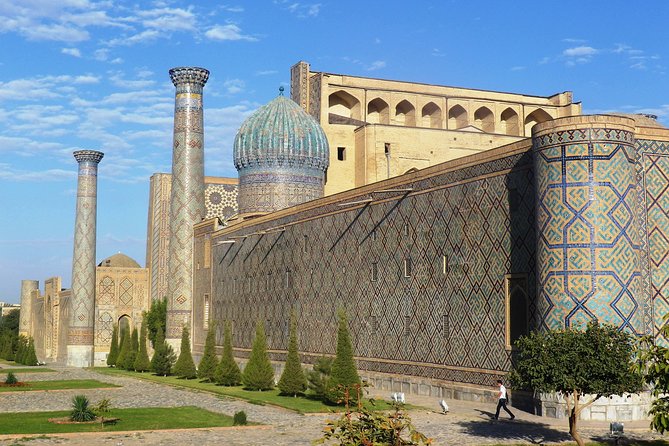
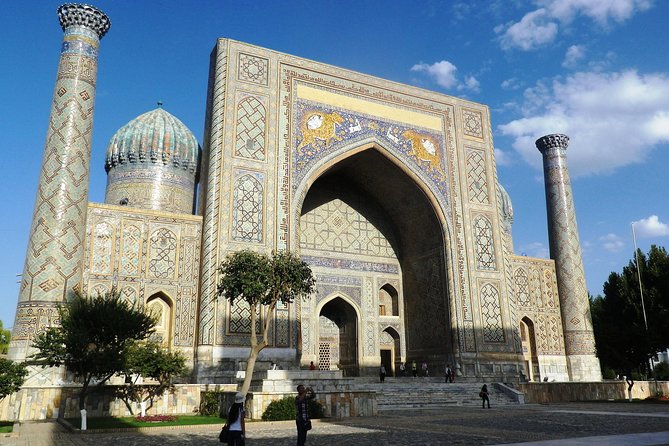
The Registan is the main event for many people visiting Uzbekistan. Three grand madrassas frame the square, creating one of Central Asia’s most memorable architectural scenes. The audio helps you move beyond the familiar picture and understand why this place has such force.
The route connects the Registan to the wider intellectual world of the region. It refers to Al-Khorezm, the mathematician whose name reached the West through the word algorithm. That kind of connection is useful because it places Samarkand in a story of science, learning, and exchange, not only conquest and royal display.
You get a sense of how deeply the city is tied to the history of Central Asia. The Registan is not just a dramatic square for photographs. It reflects the role of education, religion, government, and public ceremony in the city’s past.
Allow extra time here if you care about details. The one-hour estimate describes the audio route, not the total time you should spend at the square. Tickets are not included, and some parts of the Registan complex may require separate entry arrangements. Check local conditions when you visit.
The audio works best here as a prompt. Listen to the section connected to the square, then put the phone away for a few minutes and take in the proportions, tile patterns, and relationship between the buildings. A good city guide should help you look up, not keep your eyes fixed on a screen.
Sher Dor Madrassa and the detail photographers seek
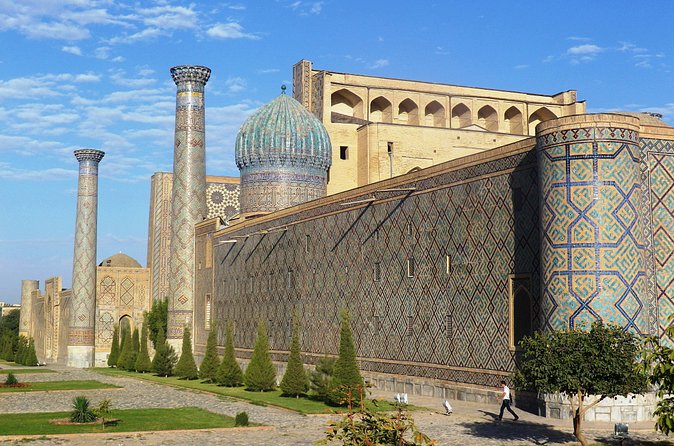
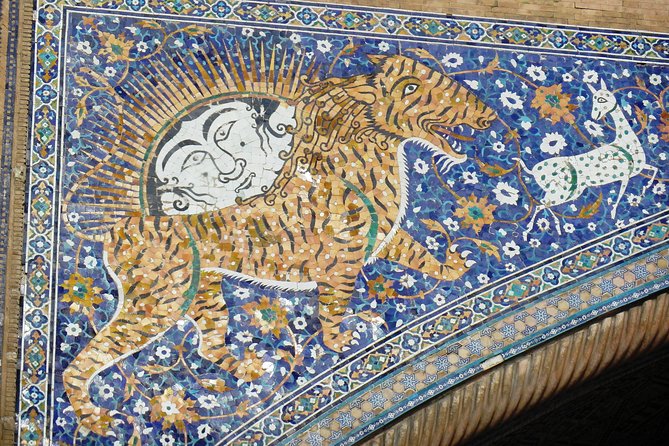
The final featured stop is the Sher Dor Madrassa, completed in 1636 under Shaybanid Emir Yalangtush. It was built as an imitation of the original Ulugbek Madrassa, but it is not an exact copy.
The building has a quirk that makes it especially popular with photographers. Its decoration includes unusual imagery for a religious building of this kind, and the audio points you toward the detail so you know where to look. That is a good example of the value of location-based narration: you do not need to arrive with specialist knowledge to notice something unusual.
Sher Dor also rounds out the story of the Registan. The square is not a single moment frozen in time. Its buildings reflect different periods, rulers, and design choices. Hearing how Sher Dor relates to Ulugbek Madrassa gives you a clearer way to compare the structures rather than treating the whole square as one decorative wall.
The route ends on Tashkent Road. That finish gives you a practical reference point, but it does not include onward transport. Plan your next move before beginning, especially if you want to continue sightseeing elsewhere in Samarkand.
What the app does well, and where it needs patience
The VoiceMap application provides the audio, maps, and geo-data. Offline access is a real advantage. You can download the material before setting out, then follow the route without needing a live connection.
The GPS system also gives you control. You can stop for food, photos, shopping, or prayer, then resume when ready. Lifetime access means you are not limited to one attempt. You could use the tour again on a later visit, or replay sections after seeing the sites for yourself.
The first few minutes may take patience. You need to find the precise start point, allow the app to recognize your location, and learn how the controls work. One practical tip is to test the pause and resume functions before you begin walking. That small bit of preparation can save frustration later.
GPS is not magic. Buildings, crowded areas, or an inaccurate position can affect when a recording starts. Keep the map open enough to confirm your location, and do not worry about stopping the audio manually if you want to spend longer at a site.
There is no live guide to answer questions, adjust the route, or point out something unexpected. That makes this a poor fit if you want personal conversation. It is a good fit if you prefer privacy and dislike being hurried by a group.
Is $6.99 good value?
At $6.99 per person, this is an inexpensive way to add structure to a day in Samarkand. The price is especially reasonable if you use the route as an introduction to the city’s main sights and return to the places you want to inspect more closely.
The value comes from the combination of storytelling, offline navigation, and lifetime access. You are not paying for transport, admission, meals, or a personal guide. You are paying for a compact audio program that helps connect five important stops.
That distinction matters. If you already have a detailed guidebook, a local guide, or a strong plan for Samarkand, the tour may overlap with what you know. If you are exploring independently and want context without committing to a larger tour, the cost is easier to justify.
Think of it as a low-cost layer added to your sightseeing, not a complete Samarkand package.
Who should choose this tour?
I would recommend it for independent visitors who want a clear route but do not want to join a group. It suits solo visitors, couples, and small private parties who like to stop often and set their own rhythm.
It is also useful if you have only a short amount of time in central Samarkand. The route identifies several major sights and adds a local market and teahouse angle, so you get more than a monument checklist.
You may want something else if you need transport, entrance tickets, a human guide, or detailed answers to questions. Families should also consider how well children will respond to a GPS audio format, since the tour depends on listening and walking rather than hands-on activities.
Service animals are allowed, and the activity is near public transportation. Most people can participate, but you still need your own smartphone. The experience is listed as private, meaning only your group participates, though no live guide accompanies you.
Should you book it?
Book this tour if you want a cheap, flexible introduction to Samarkand and are comfortable managing an app. The best parts are the thoughtful route, the contrast between sacred sites and Siab Bazaar, and the stories that give Shah-i-Zinda, Bibi Khanym, the Registan, and Sher Dor more meaning.
Skip it if you want a polished guided walk with no setup, transport, or admission decisions. Download the content first, begin at the exact Shah-i-Zinda meeting point, and give yourself more than one hour if you plan to explore the monuments properly.
One final practical point: the booking is non-refundable and cannot be changed. Make sure your dates and phone setup are in order before paying.
FAQ
How long does the Samarkand audio tour take?
The tour takes approximately one hour. You may spend longer if you stop to explore the sights, visit the bazaar, or take breaks.
What sights are included?
The route includes Shah-i-Zinda, Siab Bazaar, Bibi Khanym Mosque, the Registan, and the Sher Dor Madrassa.
Where does the tour start?
It starts on Shah-i-Zinda Street, at Shоhi Zindа ko’chasi in Samarkand.
Where does the tour finish?
The route ends on Tashkent Road in Samarkand.
Do I need an internet connection during the tour?
No. Offline access to the audio, maps, and geo-data is included. Download the material before you begin.
Is a smartphone provided?
No. You must bring your own smartphone.
Is transportation included?
No. Transportation is not included.
Are entrance fees included?
No. Tickets for museums or other attractions along the route are not included.
Can I pause and resume the audio?
Yes. The GPS format lets you follow the route at your own pace, and the audio can be paused and resumed. The app may take some initial practice to use comfortably.
Can I cancel or change my booking?
No. The experience is non-refundable and cannot be changed for any reason.
Just added around Samarkand
- Uzbekistan 6 Days Private Tour Khiva-Bukhara-Samarkand by Train★ 5.0 · 4 reviews
- Private Intercity Transfer Tashkent – Samarkand – Tashkent★ 3.5 · 3 reviews
- Tashkent-Samarkand-Bukhara tour-3nights/4 days★ 5.0 · 5 reviews
- 6- Day Private Tour to Tashkent, Khiva, Bukhara and Samarkand★ 5.0 · 5 reviews
- Samarkand Capital of Amir Timur Private Tour with Transport★ 5.0 · 3 reviews
- Seven Lakes Panjakent: One-Day Adventure from Samarkand★ 5.0 · 3 reviews
- Shakhrisabz Private Day Tour from Samarkand★ 5.0 · 4 reviews
- Tadjikistan 7 Lakes Day Trip from Samarkand with Lunch★ 5.0 · 5 reviews
City Tours, compared.
Private Samarkand City Tour With Transportation
Read our review →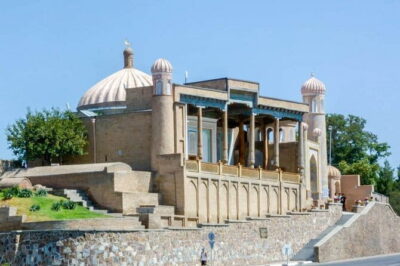
A City Tour Of Samarkand: The Pearl Of The East
Read our review →

Browse the lists this tour appears in