
Reviewed · CITY TOURS
A City Tour Of Samarkand: The Pearl Of The East
Samarkand’s great sights are spread across a walkable historic core, and this 3.5-hour tour links the essential five without making you puzzle out the order yourself. You move from Tamerlane’s tomb to the grand Registan, then on to mosques and the tiled lanes of Shah-i-Zinda.
I like the low $16 price, especially for a guided introduction, and I like the guides’ flexible teaching style. Fayoziddin is praised for clear stories, humor, restaurant advice, and good timekeeping, while Sitora brings warmth and energy. The main catch is simple: most entrance fees are extra, and the tour gives you an overview rather than long, independent visits inside every monument.
Key points at a glance
- Five major sights in one half-day: Gur Emir, Registan, Bibi Khanym, Hazrat Khizr, and Shah-i-Zinda.
- A strong first look at Samarkand: You get the historical setting before deciding where to return on your own.
- Guides who make the past approachable: Fayoziddin and Sitora are especially praised for humor, clarity, and personal attention.
- Walking with travel time built in: The listed stop times add up to about three hours, with the remaining time used to move between sites.
- Good value at $16: Guide service and walking are included, while monument entry costs about $6 extra.
- A moderate physical outing: You need to walk comfortably, and the tour is not suited to people with serious leg problems.
Samarkand can feel like a string of separate wonders. Gur Emir sits near the city center, Registan opens into a huge formal square, Bibi Khanym rises across from the old market area, and Shah-i-Zinda stretches along a sacred hillside. This tour gives those places a connecting story.
That matters because the monuments are more than pretty facades. They reflect the power of Amir Timur, the scholarship of the Timurid era, Islamic tradition, later rebuilding, and the modern effort to preserve Samarkand’s famous blue tilework. A good guide helps you see how the pieces fit together.
The experience is led by the provider, Fayoziddin, with guides including Fayoziddin, Sitora, and Javlonbek. The exact guide may vary, but the strongest accounts describe a well-organized walk with English explanations, time for photographs, and room for questions.
The group can reach a maximum of 20 people. That is not a private tour, but it is still small enough to hear a guide without the feel of a huge coach outing. Some dates may be much smaller. One account describes a solo departure that still ran, with the guide adjusting kindly when rain made the walk harder.
Gur Emir: Beginning with Tamerlane’s Tomb
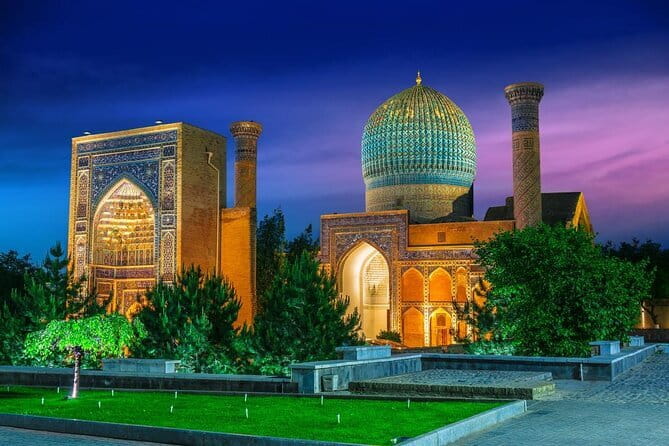
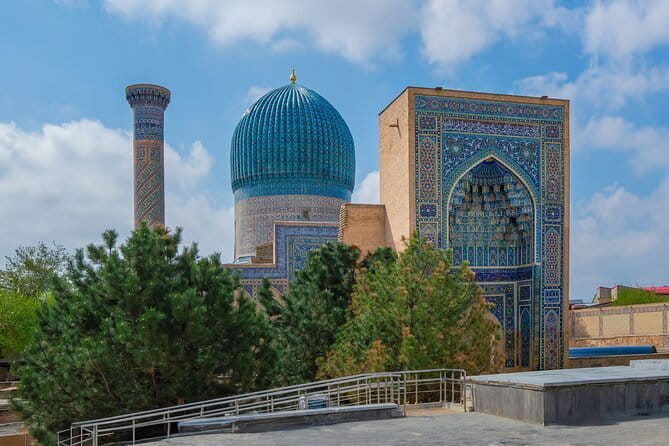
The tour begins at the Gur Emir Mausoleum, the burial place of Amir Timur, also known as Tamerlane, along with members of his family. His beloved grandson Muhammad Sultan, the scholar-ruler Ulugbek, and other relatives are buried here.
This is a smart starting point. Gur Emir is not as vast as Registan, so you can take in its scale while learning the main personalities who shaped Samarkand. The guide explains the building’s design, Timur’s ambitions, and the stories tied to the mausoleum.
Inside, the setting is more intimate than the grand public squares that follow. You will want time to study the dome, ornament, and tomb markers, but remember that the admission fee is not included. The stop is scheduled for about 50 minutes, though part of the overall tour time is used moving between sites.
I especially like beginning here because it gives the rest of the walk a human story. You are not just looking at blue tile. You are hearing about a ruler who wanted Samarkand to be a capital worthy of a vast empire, and about the family members whose lives shaped the city after him.
More City Tours in Samarkand
- Private Samarkand City Tour With Transportation
★ 5.0 · 149 reviews - Private Guided Tour Samarkand city history and culture
★ 5.0 · 22 reviews - Samarkand Historical City Highlights Guided Walking Tour
★ 5.0 · 22 reviews
Registan Square: Samarkand’s Great Classroom
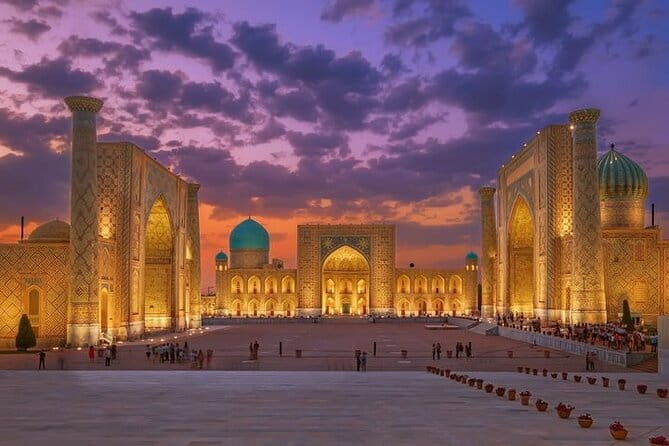
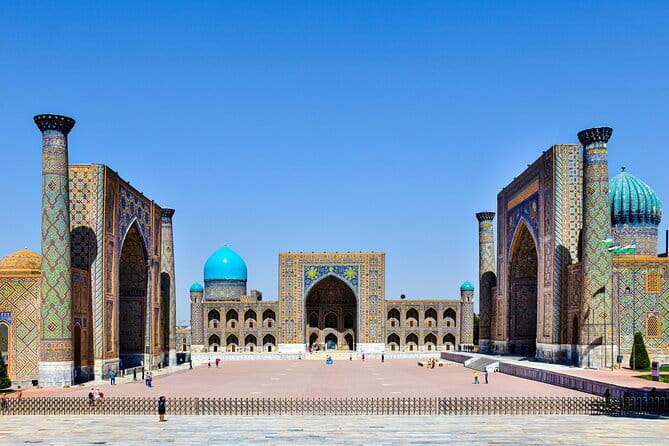
Registan is the visual center of the tour and the place where the scale of Samarkand really hits you. The square is framed by three monumental madrasahs: Ulugbek, Sherdor, and Tilla-Kari.
From the 15th through the 17th centuries, this was an educational and spiritual center. Your guide explains the role of each school and points out the different decorative approaches. The buildings look related, but they are not identical, and the details make more sense once you know what to watch for.
Ulugbek’s madrasah connects the square to the astronomer and ruler Ulugbek, whose interests reached beyond court politics. Sherdor is known for its striking facade, while Tilla-Kari adds a richly decorated mosque to the ensemble. The guide uses these differences to keep the explanation from becoming a blur of dates and names.
You are given time for photographs and a look around, but the monument entry is extra. One practical account places the fee at about 75,000 Uzbek som, while the tour information gives an estimated total monument cost of $6. Prices can change, so carry funds for admission.
The tour’s Registan visit is best treated as an orientation. You will see the main design, understand the basic history, and learn when it may be worth returning for a slower look. If tiled interiors and architectural details are your main reason for coming to Samarkand, plan extra time here after the walk.
Bibi Khanym: A Monument to Ambition
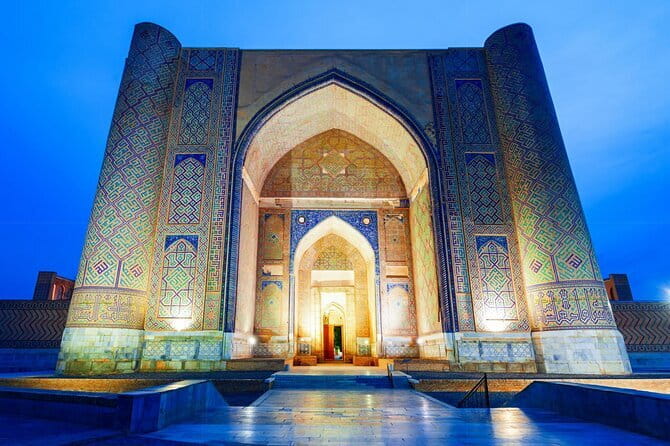
Bibi Khanym Mosque appears next, and the tour views it from outside. Its huge blue dome and broad arch make it easy to understand why the building is tied to Amir Timur’s ambition to create one of the finest mosques in the world.
The guide adds legends and stories connected with the construction. This is useful because Bibi Khanym is not a quiet, modest building. Its scale is the point. You stand before a structure designed to announce power.
The scheduled stop lasts about 40 minutes, but no interior visit is included in this part of the tour. That is both a strength and a limitation. You get the outside view and historical explanation without spending too much time at one stop, but you will need to return on your own if you want a fuller examination.
I would pay attention to the relationship between the dome, portal, and surrounding walls. From the outside, Bibi Khanym can feel almost theatrical. A guide helps turn that first impression into a story about patronage, architecture, and the risks of building on such an enormous scale.
Hazrat Khizr: A Smaller Mosque with a Long Past
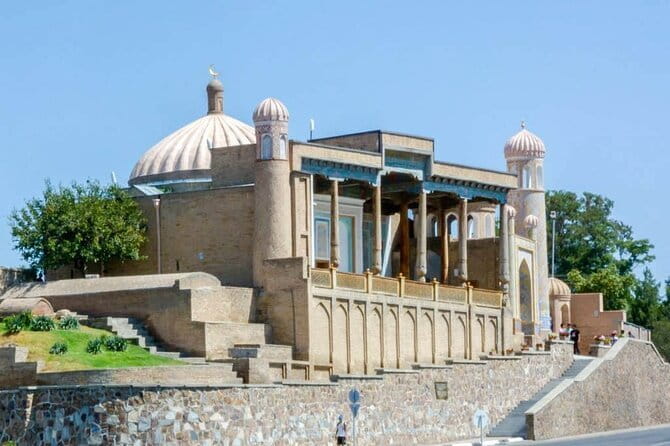
Hazrat Khizr Mosque offers a change of mood. The present mosque was reconstructed in the 19th century after the earlier building was destroyed in the 13th century. The original mosque on this site dates to the 8th century.
The stop is scheduled for about 30 minutes, and admission is included here. Compared with the huge monuments, this can feel more personal and easier to absorb. The age of the site gives the guide a chance to discuss how Samarkand’s sacred places have been damaged, rebuilt, and used across many centuries.
This stop also helps break up the grand imperial story. Samarkand is not only about Timur and royal projects. It is also a religious city with older layers beneath the monuments most often shown in photographs.
You may find the pace here refreshing. The tour covers a lot, so a shorter stop at a smaller mosque keeps the day moving while still adding historical depth.
Same city, a completely different kind of day:
- Samarkand: Historical Monuments Guided Walking Tour
★ 4.8 · 446 reviews - Samarkand One Day Tour – Departure From Tashkent
★ 5.0 · 313 reviews - Full Day Private Tour in Seven Lakes from Samarkand
★ 5.0 · 94 reviews - Samarkand One Day Tour: one day walking & group tour
★ 4.4 · 87 reviews
Shah-i-Zinda: Ending Among the Tilework
The final stop is Shah-i-Zinda, a memorial complex often regarded as one of Samarkand’s most mysterious architectural places. Tradition connects it with the grave of Kusam ibn Abbas, described as an associate of the Prophet Muhammad.
The complex is made up of mausoleums and sacred buildings arranged along a narrow route. The approach feels different from the open space of Registan. Instead of one giant square, you move through a sequence of facades, tiled surfaces, domes, and passages.
The planned visit lasts about 45 minutes, and admission is extra. Because the tour ends here, Shah-i-Zinda deserves a little planning. You will not be returned to your starting point, so this is a convenient place to continue exploring if your accommodation or next stop lies nearby.
I would save energy for this final section. The walk is moderate rather than extreme, but the day includes several monuments, uneven walking may occur, and Shah-i-Zinda rewards patience. Look closely at the tile patterns instead of rushing through for one photograph.
The tour ends at the Shah-i-Zinda Mausoleum on Shohi Zinda ko’chasi. That endpoint is useful, but it also means you should know how you plan to get back afterward.
What the Guides Add to the Walk

The strongest part of this experience is the way the guides handle a large amount of material in a short time. Fayoziddin is described as a teacher who guides part time, and that background shows in the way he structures explanations. He gives context, keeps the group moving, and uses humor to prevent the history from becoming a list of rulers.
He is also praised for practical help. You may receive suggestions for restaurants, advice on which sights deserve a return visit, and tips about the best time to see places properly. One memorable stop included a break for coffee and a pastry, while another rainy outing included time in a warm cafe.
Sitora is described as cheerful, funny, and well informed. Her approach seems especially suited to people who want history delivered in a relaxed way rather than as a formal lecture. Javlonbek is also noted for enthusiasm and for bringing prepared material, including images that show sites before restoration.
Guide quality can vary by date, but the pattern is clear: expect storytelling, not just directions from one monument to the next. The guide may ask about your background and keep the group conversation friendly. That can make a group walk feel more personal.
There is one fair criticism to keep in mind. The tour can lean strongly toward religious and monumental history, while giving less attention to the wider Asian and Central Asian story. If you want a fuller picture of trade, Soviet-era life, local customs, or modern Uzbekistan, use this walk as a starting point and ask questions.
Price, Pace, and What You Actually Get
At $16 per person, this is inexpensive for a guided half-day in Samarkand. You pay for the guide and walking service, while monument entry fees are not included except at Hazrat Khizr. The tour information estimates the remaining entrance cost at $6.
That separation is worth understanding before you book. The headline price is low, but your real cost will be higher if you enter the paid monuments. In return, you get a route that covers five important sites, historical interpretation, and help deciding where to spend more time later.
The stop durations total roughly three hours and 10 minutes. The stated tour length is about three and a half hours, with the remaining time used for walking and travel from the starting point to the final stop. This is a brisk introduction, not a full day at each monument.
I like that balance for a first day in Samarkand. You can see the major sights, learn their basic stories, and then return to the places that caught your eye. If you already know the city well or want long photography sessions, the fixed pace may feel too quick.
The walk requires moderate physical fitness. You need to be able to walk between the sights, and the experience is not recommended if you have serious leg problems. Service animals are allowed, and the start is near public transportation.
Who Should Book This Samarkand Walk?
I would choose this tour if you have limited time, want a strong first look at Samarkand, or prefer having the city’s monuments explained before exploring alone. It also suits solo visitors, since the tour can still run with very few participants.
It is a good match for history-minded visitors who like stories about rulers, religious buildings, architecture, and local legends. It also works well for anyone who wants restaurant suggestions and practical advice for the rest of a Samarkand stay.
I would hesitate only if you want a slow, private visit inside every monument. The route is busy, several admission fees are extra, Bibi Khanym is viewed from outside, and the group moves on after each scheduled stop.
Free cancellation is available if you cancel at least 24 hours before the start time. Changes or cancellations made within 24 hours are not refunded, and the cut-off uses local time.
Should You Book It?
Yes, if you want an affordable and well-paced introduction to Samarkand’s central monuments. The combination of Gur Emir, Registan, Bibi Khanym, Hazrat Khizr, and Shah-i-Zinda gives you the city’s essential visual story in one walk.
Book it with the right expectation: this is your Samarkand primer, not the final word on every site. Bring comfortable walking shoes, allow about $6 for monument entry, and keep part of another day free so you can return to Registan or Shah-i-Zinda at your own speed.
FAQ
How long does the Samarkand city tour last?
The tour lasts approximately 3 hours and 30 minutes, including travel time between the meeting point, the stops, and the final drop-off point.
Which sights are included?
The route includes Gur Emir Mausoleum, Registan Square, Bibi Khanym Mosque, Hazrat Khizr Mosque, and the Shah-i-Zinda memorial complex.
Where does the tour start?
The tour starts at the Amir Temur Mausoleum, also called the Gur-i Amir Complex, on Oqsaroy 1, Bo’stonsoy Street 1/4, near Universitetskiy Boulevard.
Where does the tour end?
The tour ends at the Shah-i-Zinda necropolis on Shohi Zinda ko’chasi, at the Shah-i-Zinda Mausoleum.
Are entrance fees included in the price?
Guide service and the walking tour are included. Monument entrance fees are generally extra, with the tour information listing an estimated additional cost of $6. Admission to Hazrat Khizr Mosque is included.
How much does the tour cost?
The listed price is $16 per person. Group discounts may be available.
How many people can join?
The tour can have a maximum of 20 participants. Some departures may be smaller, depending on bookings.
Is the tour physically difficult?
The difficulty level is described as medium, and you need to be able to walk between the sights. It is not recommended for people with serious leg problems.
Just added around Samarkand
- Uzbekistan 6 Days Private Tour Khiva-Bukhara-Samarkand by Train★ 5.0 · 4 reviews
- Private Intercity Transfer Tashkent – Samarkand – Tashkent★ 3.5 · 3 reviews
- Tashkent-Samarkand-Bukhara tour-3nights/4 days★ 5.0 · 5 reviews
- 6- Day Private Tour to Tashkent, Khiva, Bukhara and Samarkand★ 5.0 · 5 reviews
- The Golden City of Samarkand: A Self-Guided Audio Tour★ 4.0 · 4 reviews
- Samarkand Capital of Amir Timur Private Tour with Transport★ 5.0 · 3 reviews
- Shakhrisabz Private Day Tour from Samarkand★ 5.0 · 4 reviews
- Tadjikistan 7 Lakes Day Trip from Samarkand with Lunch★ 5.0 · 5 reviews
City Tours, compared.
Private Samarkand City Tour With Transportation
Read our review →
Browse the lists this tour appears in