Reviewed · MULTI-DAY TOURS
Uzbekistan 8 Days Private Tour Tashkent-Urgench-Bukhara-Samarkand-Tashkent
Khiva’s walled old town, Bukhara’s age-darkened brickwork, and Samarkand’s grand blue-tiled monuments make this eight-day private tour a strong introduction to Uzbekistan. You cover four major cities without managing every transfer yourself, and guides such as Tulkin in Khiva, Behrus in Bukhara, Jusra in Samarkand, and Nusrat in Tashkent are assigned along the way.
I like the practical mix of private guiding and high-speed trains, which keeps the trip personal while avoiding long overland rides. I also like the free time in Bukhara and Samarkand, since you can rest or add an optional half-day outing rather than follow a packed schedule every hour.
The main catch is the pace. You move from Tashkent to Urgench, Khiva, Bukhara, Samarkand, and back to Tashkent in just eight days. The domestic flight from Tashkent to Urgench is not included, and train times can depend on availability, so you should confirm those details before booking.
Key points to know before booking
- Khiva is the visual highlight: Itchan Kala packs minarets, madrasas, palaces, and mosques into a walkable walled center.
- Bukhara gives you the best old-city wandering: Lyab-i-Hauz, the trading domes, and the Poi Kalyan area are easy to connect on foot.
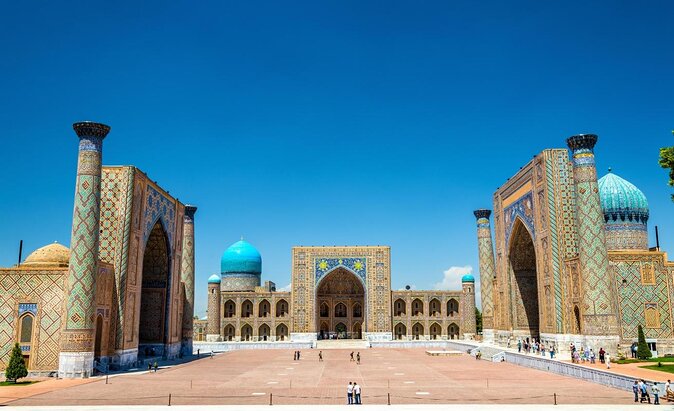
- Samarkand brings the big monuments: Registan, Gur Emir, Shah-i-Zinda, Bibi Khanym, and Siab Bazaar fill a full sightseeing day.
- The trip is private: Only your own group joins the guides, with drivers meeting you at airports and train stations.
- Transport is a major part of the value: Khiva to Bukhara, Bukhara to Samarkand, and Samarkand to Tashkent are arranged by train.
- Budget for extras: The Tashkent to Urgench flight, tips, photo fees, and any single-room supplement are separate.
Why this route works in eight days
Uzbekistan is spread out, but its best-known historic cities fit naturally into a west-to-east route. You begin in Tashkent, fly west to Urgench for Khiva, continue by train to Bukhara, then travel east to Samarkand before returning to the capital.
That routing saves you from repeating long road journeys. The private format also helps with the awkward parts of travel, including airport pickups, hotel transfers, station transfers, and entrance tickets.
You get six nights in centrally located three-star, four-star, or boutique hotels, with twin rooms and six breakfasts included. The schedule is busy, but the free blocks on Days 5 and 7 give you room to slow down.
A word of caution: this is not a leisurely single-city holiday. Day 3 includes a long train journey after a full morning in Khiva, and several sightseeing days involve plenty of standing and walking around historic sites. If you want to see the major Silk Road cities in one trip, the pace is useful. If you prefer long stays, choose a slower itinerary.
More Multi-Day Tours in Bukhara
- 2 Days Tour to Bukhara and Samarkand from Tashkent by train
★ 5.0 · 53 reviews - Uzbekistan in 7 days Tashkent, Samarkand, Bukhara and Khiva
★ 5.0 · 10 reviews - Tashkent-Samarkand-Bukhara tour-3nights/4 days
★ 5.0 · 5 reviews
Tashkent begins with modern Uzbekistan
On arrival, your driver meets you at the airport exit with a name sign and takes you to the hotel. The first day is intentionally light, which is sensible after an international flight.
Day 2 gives you a broad look at Tashkent. The Alisher Navoiy Theater, designed by Alexey Shchusev and built between 1942 and 1947, introduces the capital’s Soviet-era architecture. Admission is not included there, so check the cost if you want to enter.
At the Hazrati Imam ensemble, you move into the old city and its religious heart. The complex includes the Tillya Sheikh Mosque and other important buildings, with admission included. This is one of the more meaningful stops in Tashkent because it shows a side of the city that feels far removed from its broad modern avenues.
Amir Temur Square offers a short outdoor break. Its statue of Tamerlane, fountains, and planted paths make it a useful orientation point in central Tashkent, though you only have about 30 minutes there.
The State Museum of History of Uzbekistan adds context before the tour moves west. Founded in 1876, it is one of Central Asia’s oldest museums. An hour here can help you place the later sights in a longer historical sequence rather than seeing each monument as an isolated photo stop.
The Tashkent Metro is one of the city’s most distinctive experiences. Opened in 1977 as the first underground railway in Central Asia, its stations use marble, granite, columns, and decorative reliefs in different designs. You have about 30 minutes for this visit, which is enough for a brief look but not a full metro tour.
Later, you transfer to the airport for the flight to Urgench. The airfare starts at about $50 and is separate from the tour price. Once you arrive, a driver takes you to Khiva, where you spend the night.
Khiva packs centuries inside Itchan Kala
Khiva is the most compact and atmospheric part of the trip. Its old inner town, Itchan Kala, covers about 26 hectares and is enclosed by historic walls. Most of the Day 3 sightseeing is concentrated here, so you can walk between the major monuments without spending the day in a vehicle.
The Kalta Minor Minaret catches your eye immediately. It is famous not only for its blue-green glazed tile and majolica decoration, but also because it was left unfinished. That incomplete shape gives it a character different from the finished towers elsewhere in Uzbekistan.
Kunya Ark, the former citadel, once formed a fortified center for Khiva’s rulers. Allow a full hour here. The site helps explain how the city functioned as more than a collection of religious buildings, with government, military, and royal life gathered behind its walls.
The Pahlavan Mahmud Mausoleum is smaller in scale but important to local tradition. Pahlavan Mahmud was a poet, philosopher, strongman, and healer, and the mausoleum developed from a modest structure into a larger religious complex.
Juma Mosque is another memorable stop. Its roof is supported by 64 hand-carved wooden columns, each with its own design. The dim interior and repeated columns create a quiet contrast to Khiva’s bright exterior tilework.
The Islam Khodja complex includes a madrasa and minaret. Tash Khauli Palace, built between 1830 and 1838 for Allakuli Khan, gives you a look at Khorezm court life and decorative design. The palace is a good reason to stay with the guide rather than simply wander the main street and collect photographs.
The visit to a local silk workshop adds a human scale to the monuments. Women run the community-supported workshop, designing and hand-weaving Khiva silk carpets. It is a short stop, but it connects the city’s visual traditions with present-day craft work.
The evening train from Khiva to Bukhara takes roughly six hours. Listed departure options are 3:00 pm to 9:00 pm or 6:00 pm to midnight, so you should confirm the actual departure when booking. This is one of the tour’s less flexible stretches. You may spend much of the day sightseeing, then board a long train rather than having a relaxed evening in Khiva.
Bukhara rewards an unhurried afternoon
Bukhara is easier to enjoy at walking speed. Its historic center links mosques, trading domes, courtyards, and public squares in a way that makes free wandering worthwhile.
Lyab-i-Hauz is a natural place to begin. The ensemble was built in the 16th and 17th centuries around a pool, and it remains one of Bukhara’s most pleasant gathering places. You have an hour here, enough to understand the setting and pause before more sightseeing.
Poi Kalyan brings the classic Bukhara view. The Kalyan Minaret rises 45.6 meters and dates to 1127, making it a survivor from the Karakhanid period. The nearby mosque and surrounding buildings show why Bukhara became such an important stop on the Silk Road.
The Ark of Bukhara is more fortress than ornament. It was a royal town within a town and served as the home of Bukhara’s rulers for more than a thousand years. Plan on an hour, since the site needs explanation to make sense of its layers of power and defense.
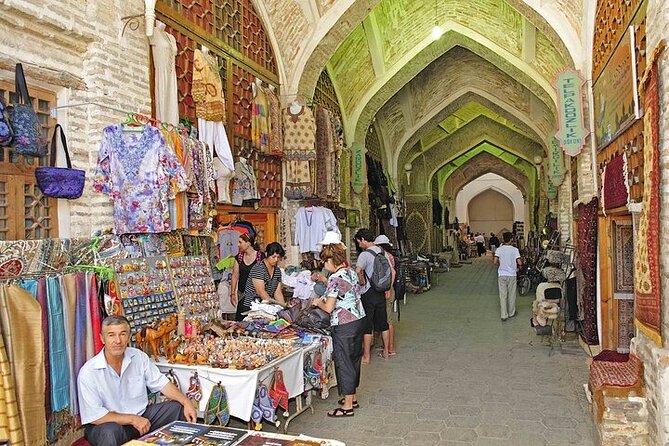
The trading domes are less formal and more social. They once organized commercial activity under covered market spaces, and today you can browse artisan workshops and small shops. You get an hour here, with no admission fee listed.
Maghak-i Attari Mosque brings an especially long timeline. The structure is associated with earlier Buddhist and Zoroastrian use before becoming a mosque, and its brickwork is a reminder that Bukhara’s religious story did not begin with Islam.
Bolo Hauz Mosque sits opposite the Ark. Its name refers to the pool in front of it, and the building’s arrangement creates a useful visual link between religious and royal spaces.
Day 5 gives you four hours to choose your pace. You can explore Bukhara on your own, or pay for an optional half-day trip into the surrounding area. That outing can include the Emir’s Summer Residence, the Bakhoutdin Naqshband Mausoleum, and the Samani Mausoleum.
Later, a transfer takes you about 15 kilometers to Kagan station. The high-speed train to Samarkand is scheduled for around three hours, subject to availability. This is a valuable change from the longer Khiva connection, but train reservations should be confirmed early.
More Multi-Day Tours in Samarkand
- 2 – Days Guided Tour of Samarkand and Bukhara from Tashkent
★ 5.0 · 5 reviews - Yurt stay and Hiking in the Nurata Mountains tour – 2 days
★ 5.0 · 35 reviews - 2 Days of Tour in Yurt Camp and Aydarkul
★ 5.0 · 15 reviews - Kyzylkum Desert tour from Samarkand (1Night 2 Days)
★ 4.3 · 7 reviews
Samarkand delivers the grand finale
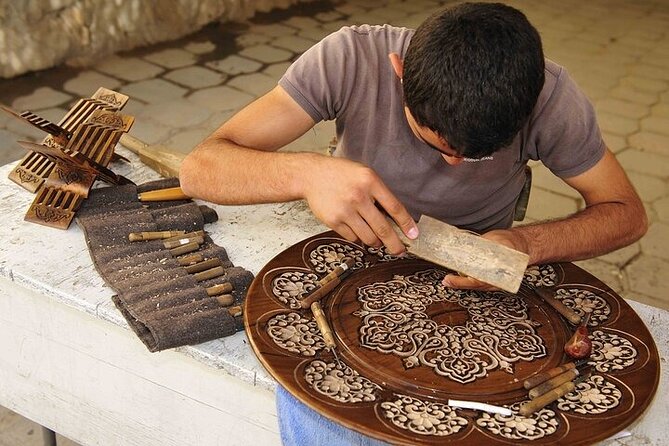
Samarkand’s main sights are large, dramatic, and closely tied to the era of Timur and his successors. Day 6 is the heaviest sightseeing day, so wear practical shoes and expect a full schedule.
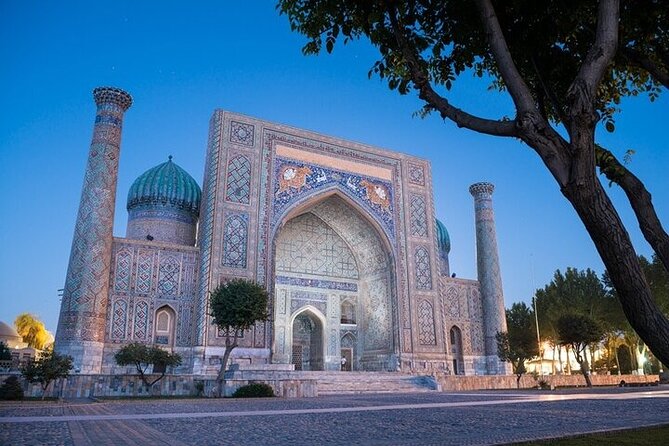
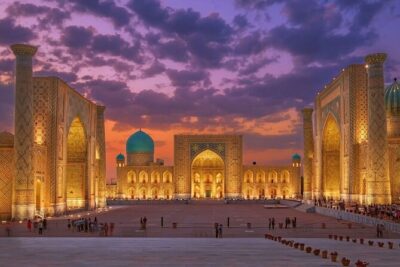
Registan is the centerpiece. The square is framed by the Ulugbek, Sherdor, and Tillokori madrasas, each with its own tile patterns and facade details. Two hours lets you look closely rather than rush through, though the scale of the buildings can easily hold your attention longer.
Gur Emir Mausoleum is connected with Tamerlane, whose tomb lies inside the beautifully restored complex. Built in 1404 and 1405, it offers a more intimate setting than Registan, with a chance to focus on the tomb’s decoration and the monument’s role in Timurid memory.
Shah-i-Zinda is a long sequence of mausoleums on the southeastern side of ancient Afrosiab. The complex includes 44 tombs across more than 20 mausoleums. Give this stop its full hour. The repeated blue tile, narrow passage, and changing facade details reward close attention.
Bibi Khanym Mosque was built on Timur’s order between 1399 and 1404 and named for his wife. Its immense scale reflects the ambition of the Timurid court, though the site also makes clear how much restoration is needed when monumental construction has endured for centuries.
Siab Bazaar provides a welcome change of rhythm. You can see produce, local goods, and handicrafts, and it gives the day a more ordinary, lived-in setting after several hours of formal monuments. The admission is included, according to the tour details.
On Day 7, you get another four-hour free block. You can continue exploring Samarkand or pay for an optional half-day visit to the Ulugbek Observatory, the Afrosiyob Museum, and the Hodji Danior Mausoleum.
The return high-speed train to Tashkent leaves in the late afternoon, subject to availability. After roughly three hours, a transfer takes you to your Tashkent hotel. The final day is only an airport transfer, so your real sightseeing ends on Day 7.
What $975 includes, and what it does not

At $975 per person, the tour offers solid value if you want a guided, organized route through four cities. The price covers air-conditioned transport, six nights of twin-room accommodation, six breakfasts, entrance fees, licensed guides in each city, and the scheduled train tickets.
The private format matters here. You are not adjusting your day to a large group, and the guides can explain sights in more detail for your own party. Drivers are arranged to meet you at airports and train stations, which removes a fair amount of arrival-day stress.
The most important extra cost is the domestic flight from Tashkent to Urgench, starting at about $50 per ticket. You also need to budget for guide and driver tips, photo museum charges of about $1 to $2 per site, and a $20 per night single-room supplement.
The two optional half-day outings are also outside the core price. This lets you control spending, but it means the advertised price is not the final cost for a solo traveler or anyone adding every extra.
Who will enjoy this private Uzbekistan route
I would choose this tour if you want the main historic cities explained by local guides but do not want to arrange every hotel, station transfer, and ticket yourself. It is especially suitable for first-time visitors who want a clear route and private transportation between airports, hotels, and stations.
The itinerary also suits couples, families, and small groups who value their own guide. The group discount may improve the price for a larger private party.
You should think twice if you dislike early starts, long train rides, or changing hotels often. The route is efficient, not slow. Also, the tour gives you only a short look at Tashkent, with far more time devoted to the historic cities in the west and east.
Guide quality is one of the strongest parts of the arrangement. The named guides include Tulkin in Khiva, Behrus in Bukhara, Jusra in Samarkand, and Nusrat in Tashkent. The trip has also earned a 4.7 rating from 38 reviews, with 97 percent recommending it, which fits the tour’s strongest features: organized transfers, helpful guides, good hotels, and a problem-free flow from one city to the next.
Should you book it?
Book this tour if your priority is seeing Khiva, Bukhara, and Samarkand in one well-managed week. The included trains, guides, hotels, admissions, and airport transfers make the $975 price easier to justify, especially for a small private group.
Before paying, confirm the Tashkent to Urgench flight price, exact train schedules, hotel names, and whether your preferred optional excursions are available. If those details work for you, this is a practical first visit to Uzbekistan, with enough free time to breathe but not enough to lose sight of the country’s main historic centers.
Free cancellation is available up to 24 hours before the start time for a full refund. Changes or cancellations inside that window are not accepted for a refund.
FAQ
How long is the Uzbekistan private tour?
The tour lasts eight days and covers Tashkent, Khiva, Bukhara, and Samarkand before returning to Tashkent.
Is this a private tour?
Yes. Only your own group participates, with a private guide arrangement and drivers for the scheduled transfers.
What is included in the $975 price?
The price includes an air-conditioned vehicle, taxes and fees, entrance tickets to the listed sights and museums, six nights in twin rooms, six breakfasts, licensed guides in each city, scheduled train tickets, visa support if needed, and 24-hour customer service.
Is the flight from Tashkent to Urgench included?
No. The domestic flight is separate and starts at about $50 per ticket.
Are the trains included?
Yes. The Khiva to Bukhara train and the high-speed trains from Bukhara to Samarkand and Samarkand to Tashkent are included, subject to schedule and ticket availability.
How many breakfasts are included?
Six breakfasts are included.
Are single rooms available?
Yes. A single-room supplement of $20 per night applies.
Are tips included?
No. Tips for guides and drivers are not included.
Are museum photo fees included?
No. Photo fees are paid in cash at the entrance and usually cost about $1 to $2 per site.
Can I explore Bukhara and Samarkand independently?
Yes. Day 5 includes about four hours to explore Bukhara independently, and Day 7 includes about four hours in Samarkand. Optional half-day tours are also available in both cities.
More Private Tours in Bukhara
- Uzbekistan 3 Day Private Tour Tashkent-Bukhara-Samarkand Bullet Train
★ 4.5 · 23 reviews - 6- Day Private Tour to Tashkent, Khiva, Bukhara and Samarkand
★ 5.0 · 5 reviews - Best of Bukhara: All Day Private Old Town Tour
★ 5.0 · 66 reviews - Best of Bukhara: All Day Private Old Town Tour
★ 4.9 · 62 reviews
More Multi-Day Tours in Tashkent
- Fergana – Golden Valley From Tashkent 1 night / 2 days
★ 4.5 · 41 reviews - 7-Day Uzbekistan with the Local: From Blue Domes to Mountains
★ 5.0 · 17 reviews - 3-Day Chimgan Trekking Tour
★ 5.0 · 10 reviews - From Tashkent: Uzbekistan Private 6-Day Tour
★ 5.0 · 6 reviews
Just added around Tashkent
- Uzbekistan Tour – 6 Days 5 Nights★ 5.0 · 4 reviews
- Private Intercity Transfer Tashkent – Samarkand – Tashkent★ 3.5 · 3 reviews
- Tashkent-Samarkand-Bukhara tour-3nights/4 days★ 5.0 · 5 reviews
- Tashkent Mountain Tour Amirsoy with Transport★ 3.5 · 3 reviews
- Tashkent City Tour with Hotel Pickup and Drop off★ 4.5 · 4 reviews
- Private Tashkent City Tour★ 5.0 · 3 reviews
- Tashkent Food and Metro Journey★ 5.0 · 4 reviews
- Transfer Tashkent Airport / Railway Station – Hotel★ 3.5 · 3 reviews
Multi-Day Tours, compared.
2 Days Tour to Bukhara and Samarkand from Tashkent by train
Read our review →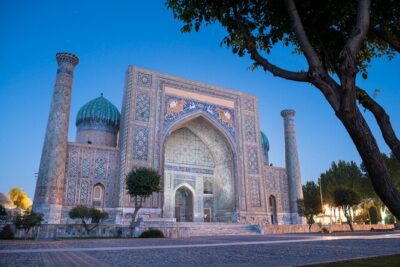
Uzbekistan 6 days private tour Tas-Khiva-Buk-Sam-Tas
Read our review →
7-Day Uzbekistan with the Local: From Blue Domes to Mountains
Read our review →