
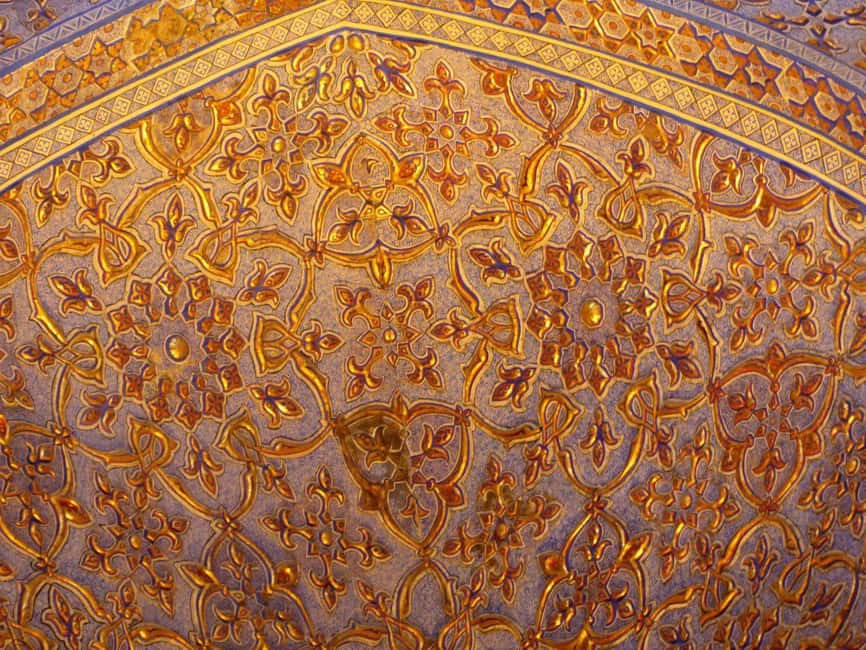
Reviewed · WALKING TOURS
Sunset walking tour of Samarkand
Samarkand changes character as daylight fades. The blue tiles of Registan Square, the lantern-lit domes of Shah-i-Zinda, and the quiet streets around Gur-i Amir feel more dramatic once the heat and crowds have eased. This walking tour links the city’s major monuments with stories about Amir Temur, Ulugbek, Uzbek customs, and local life.
I like two things here: the chance to see important sites in the cooler evening, and the personal guidance offered by local guides such as Sunnat, whose enthusiasm for Samarkand’s past comes through clearly. The main caution is timing. The tour is described as a sunset experience lasting about five hours, but some booking details have been unclear, and a late start may mean reaching Ulugbek Observatory after closing.
Key points at a glance
- Night views of Shah-i-Zinda: The necropolis can feel especially peaceful after the main daytime rush has gone.
- A strong introduction to Samarkand: Gur-i Amir, Registan, Bibi-Khanym, Shah-i-Zinda, and Ulugbek Observatory are all part of the plan.
- Local English-speaking guide: Sunnat has led many tours and is noted for adjusting explanations to suit your questions.
- Walking-focused route: You should expect several hours on foot, with comfortable shoes and clothes essential.
- Good value for solo visitors: Some departures have effectively become private tours when no one else booked.
- Check the start time carefully: Transport, meals, and entry tickets are not included, and a late departure may affect the final stop.
Why Samarkand is best seen as the light fades
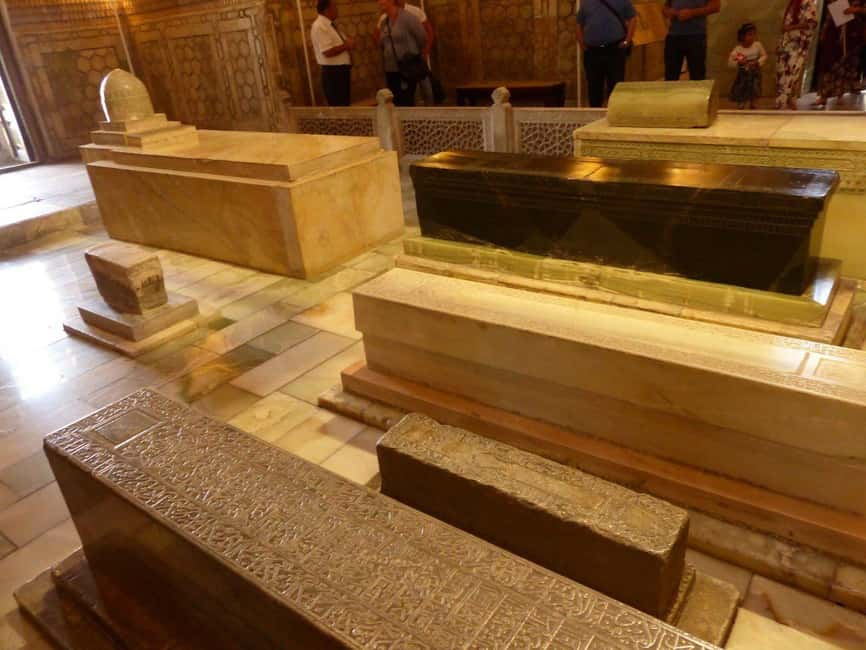
Samarkand is not a city you understand from one monument alone. Its appeal comes from the way Timurid tombs, mosques, schools, observatories, markets, and modern Uzbek life sit close together. A sunset walk gives you a useful first look at that whole story.
The tour begins at the Gur-i Amir Complex and finishes at Ulugbek Observatory. Along the way, you visit the city’s major historic sights, stop for photographs, walk through parts of Samarkand, and have time to notice local arts and crafts. The route is not simply a series of photo stops. The guide’s explanations are meant to connect the buildings with the rulers, scholars, builders, legends, and customs behind them.
I particularly like the evening setting. Samarkand can be hot in the daytime, and bright sun is not always kind to a long walking route. By late afternoon and evening, the city is easier to explore on foot. The monuments are also lit, giving the tiled facades a different mood from the one you get under harsh midday light.
The trade-off is that opening times matter. You may see the outside of a monument late in the evening, but the schedule needs to leave enough time for the places that close earlier. One booking experience ended before Ulugbek Observatory could be visited, so ask for a clear starting time and expected finish before you go.
More Walking Tours in Samarkand
- Samarkand: Historical Monuments Guided Walking Tour
★ 4.8 · 446 reviews - Samarkand One Day Tour: one day walking & group tour
★ 4.4 · 87 reviews - Samarkand: Historical Monuments Group Walking Tour
★ 5.0 · 29 reviews
Gur-i Amir, where the tour begins
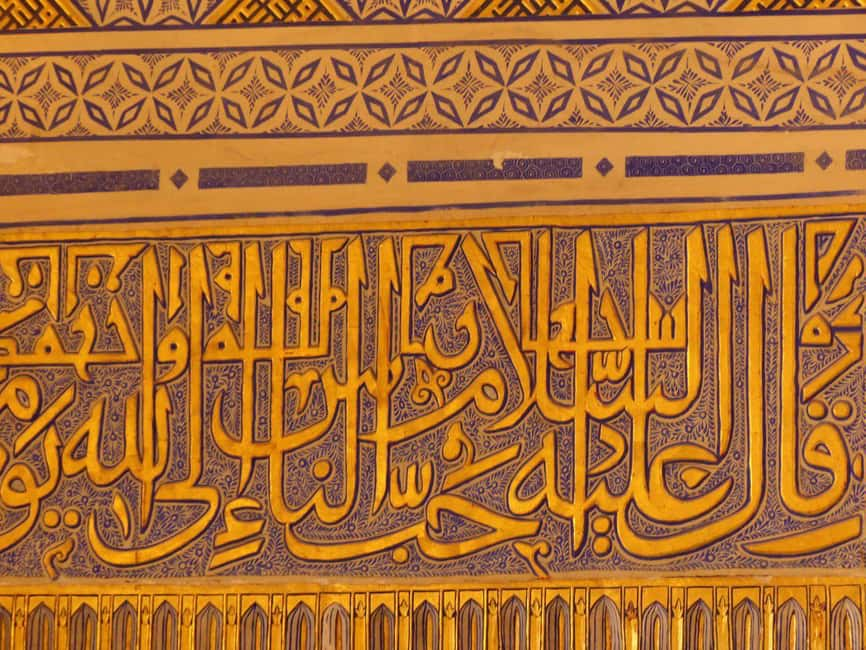
Gur-i Amir is the mausoleum of Amir Temur, often known in the West as Tamerlane. It is also the burial place of his sons Miranshah and Shahrukh, and his grandson Ulugbek. That makes the building an important starting point for understanding the Timurid family and the power that shaped Samarkand.
The first stop gives the guide a natural chance to explain who Amir Temur was and why Samarkand became so important under his rule. You can expect information about the tomb, its place in the city, and the people buried there rather than a quick exterior photograph.
The building is especially effective at dusk, when its dome and decorative surfaces begin to show against the changing sky. If you enjoy architecture, this is a good place to start asking questions about Timurid design and the difference between a mausoleum, a mosque, and a religious school.
Gur-i Amir is also a practical meeting point because it sets the historical tone at once. You begin with rulers and dynasties, then move toward the public heart of Samarkand at Registan.
Registan Square and the meaning of sandy place
Registan is the visual center of old Samarkand. Its name is explained as meaning sandy place, a reminder that the square existed as an open public space before the grand buildings that now frame it.
This is the stop where many visitors first grasp the scale of Samarkand’s Timurid and post-Timurid architecture. The square is surrounded by monumental madrasas, with ornate tilework and large arched entrances designed to impress from a distance. Your guide can help separate what you are seeing from the usual quick description of it as simply a beautiful square.
The evening is a sensible time to visit. The temperature is usually more comfortable than during the afternoon, and the lighting can bring out the geometric decoration. You also have a better chance of enjoying the space without the same level of daytime activity.
Still, do not assume that sunset automatically means every interior is open. The tour information highlights opportunities to enter several sites after ordinary visiting hours, but the exact access can depend on the day and the timing. Treat the outside views and the guide’s explanation as an important part of the visit, even if a particular interior is unavailable.
Bibi-Khanym Mosque and a famous building legend
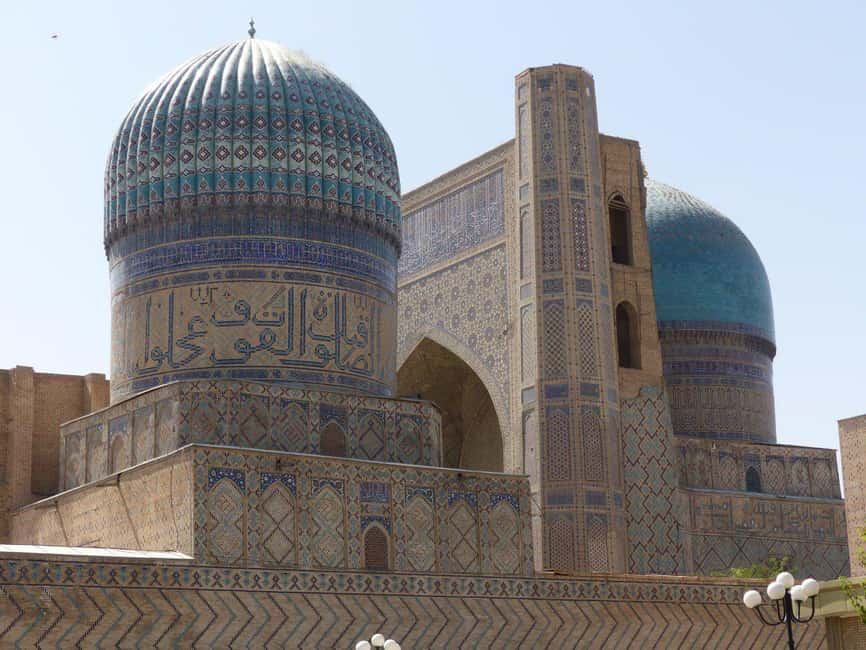
Bibi-Khanym Mosque is a 15th-century cathedral mosque and one of Samarkand’s most imposing historic buildings. Its scale reflects the ambition of the period and helps explain why the city became a center of power, religion, and learning.
Here, the guide tells the legend of an architect who fell in love with Tamerlane’s wife while supervising construction. It is a memorable story, but it works best when treated as part of Samarkand’s tradition of blending documented history with dramatic local tales.
I find this kind of explanation useful because it gives you more than dates and names. You learn how people remember the monument and how stories become attached to famous buildings. Ask the guide which details are firmly recorded and which belong to legend if you want a clearer sense of the difference.
Bibi-Khanym is another place where the route can be better in the evening. The vast facade is easier to appreciate when you are not standing in strong heat, and its proportions make more sense when you have time to stop and look instead of rushing between daytime visits.
More evening and night tours in Samarkand:
- Samarkand Moonlight Tour: A Timeless Night Experience
★ 5.0 · 6 reviews - Tashkent : Classic City Tour. (Day & Night Shift)
★ 4.8 · 52 reviews - Tashkent city Night Tour with Dinner & Free Pro Photography
★ 5.0 · 7 reviews
Shah-i-Zinda after the crowds
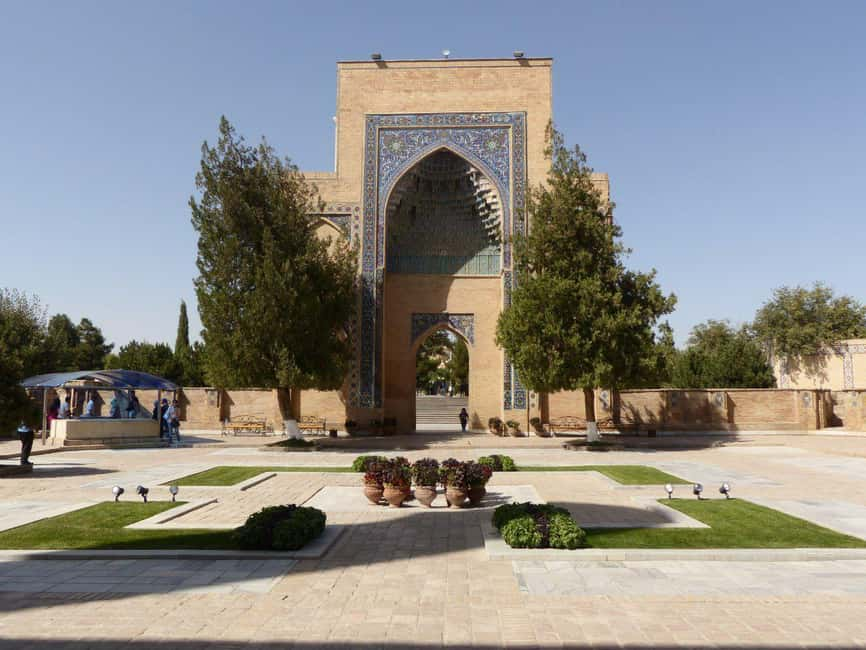
Shah-i-Zinda is a necropolis made up of mausoleums connected with Karakhanid and Timurid nobility. The name translates as living king, yet the complex is often described as the city of the dead. The guide explains the reason for this striking name and places the site within Samarkand’s religious and architectural story.
For many people, this is the emotional high point of the walk. The narrow passage of mausoleums, glazed tiles, patterned surfaces, and changing levels creates a more intimate experience than the broad openness of Registan. After dark, the site can feel quiet and reflective, particularly when there are few other people around.
This is also where the timing of the tour matters most. A late visit may provide a rare chance to see the complex without the usual daytime crowd, but access after official closing cannot be guaranteed in every situation. One particularly successful tour reached Shah-i-Zinda after hours, with almost no one else present. That kind of visit can be memorable, but you should confirm what is planned rather than assume it will happen.
Wear shoes with a good grip. The tour is a walking experience, and a long route through historic compounds is not the place for thin sandals or formal footwear.
Ulugbek Observatory and the tour’s timing problem
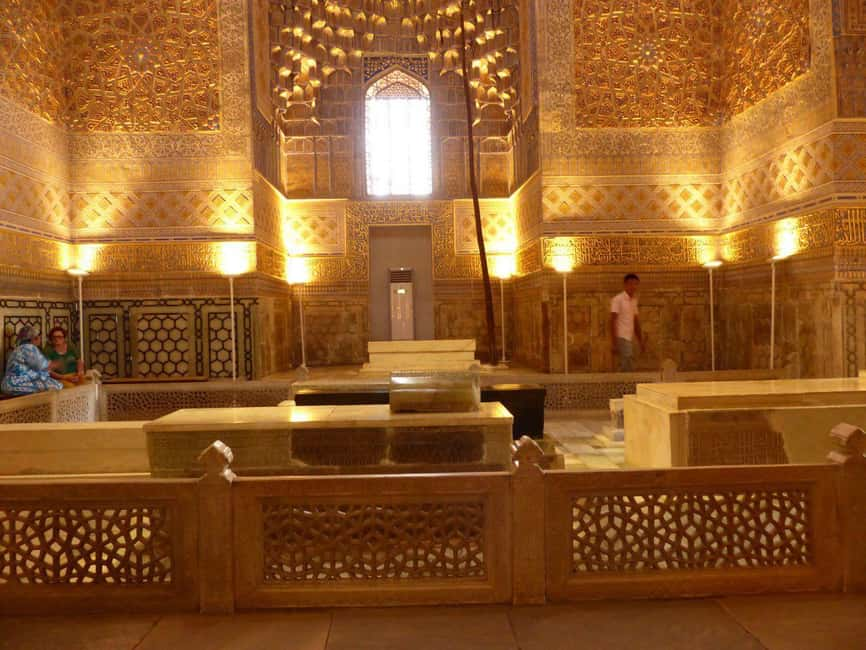
The final stop is Ulugbek Observatory, built by Ulugbek, a Timurid ruler, educator, and astronomer. It represents a different side of Samarkand from royal tombs and grand mosques. Here, the focus shifts toward science, mathematics, and the study of the sky.
That contrast gives the route a satisfying shape. You begin with Amir Temur’s dynasty, see the city’s religious and civic monuments, then finish with Ulugbek’s interest in astronomy. The observatory helps show that Timurid Samarkand was not only concerned with conquest and ceremony.
However, this is the stop most vulnerable to a late start. The experience is described as a full-day-valid activity with a roughly five-hour itinerary, while some timing information has been unclear. One participant missed the observatory because it was closed by the time the earlier monuments had been covered.
I recommend asking three questions before setting out:
- What exact time does the walking tour begin?
- Will Ulugbek Observatory be visited inside, or only seen from outside?
- What is the expected finishing time?
Those answers will help you decide if this works as your main Samarkand sightseeing plan or as an evening overview after visiting some monuments independently.
Walking, transport, and the real shape of the route
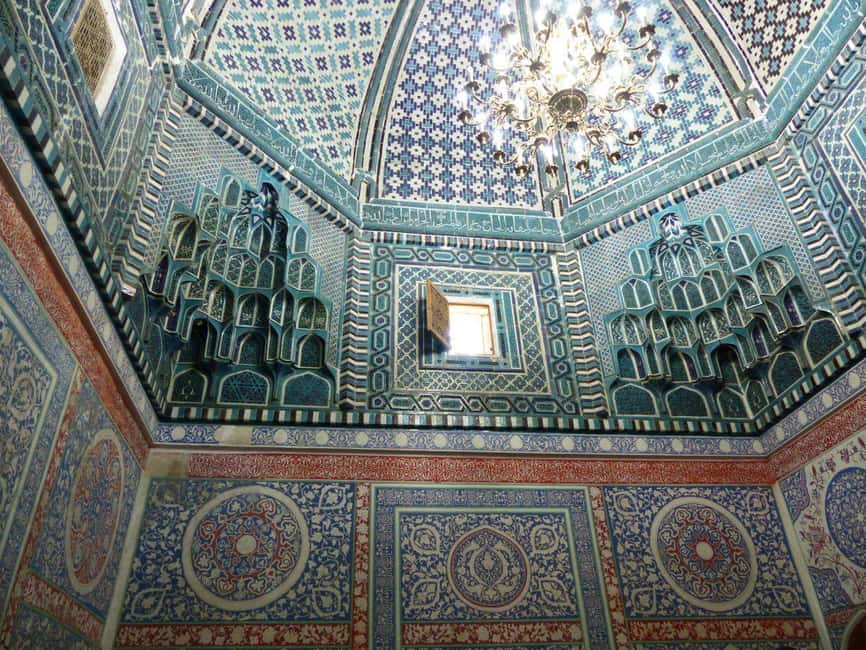
The route begins at Gur-i Amir and ends at Ulugbek Observatory. Transport is not included, so you need to arrange your own way to the starting point and from the final stop. Meals are also not included, although the schedule allows time for a picnic and a visit to an arts and crafts market.
The supplied timing describes around five hours for sightseeing, walking, photographs, scenic views, and the market visit. That is a substantial period on foot. You should wear comfortable shoes and clothes, carry water, and avoid planning a demanding activity immediately afterward.
The tour is listed as wheelchair accessible, but the route includes walking through historic complexes and outdoor areas. If you use a wheelchair, confirm the precise route and access arrangements before booking, especially for older sites where surfaces and entrances may vary.
The group size can make a big difference. Several departures have been private in practice when only one person booked. That can be excellent value if you want to ask questions, change the pace, or focus on architecture, religion, astronomy, or modern Uzbek life.
The guide makes the difference
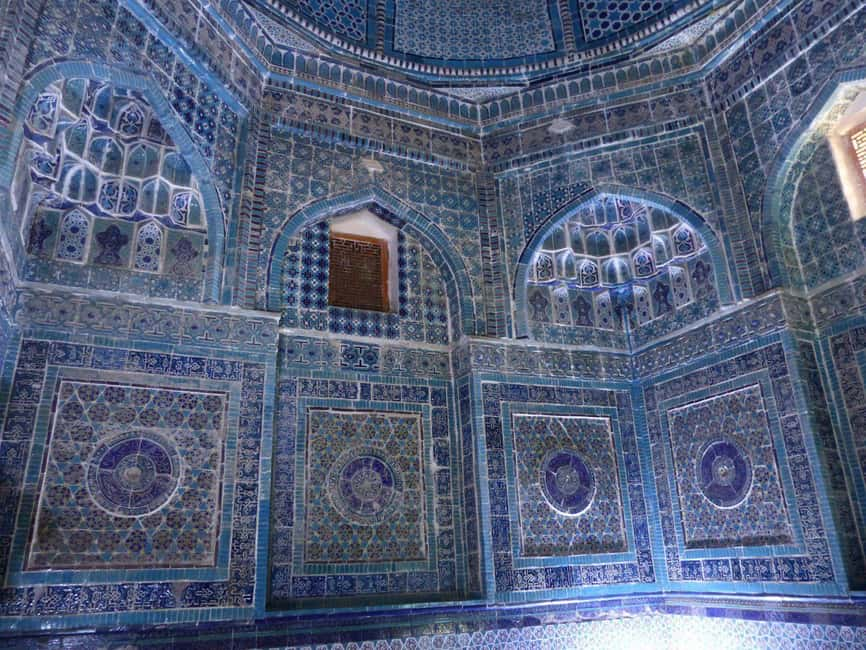
The strongest part of this experience is the guide service. Sunnat is repeatedly described as punctual, polite, enthusiastic, and eager to explain Samarkand’s past. He is also willing to adjust the discussion around your interests and questions.
That flexibility matters. A fixed speech about five monuments can become tiring, especially after several hours of walking. A good guide can slow down at the site that interests you most, explain local customs, or connect the monuments with present-day life in Uzbekistan.
You can expect the tour to include more than architecture. The experience also introduces Uzbek culture and customs, and one useful aspect is the chance to speak with a young person from the local community about both history and life in Uzbekistan today.
The guide’s enthusiasm is a real benefit, but you should still take responsibility for the focus you want. Tell the guide early if you prefer archaeology, religion, architecture, astronomy, or everyday life. The tour becomes more useful when your interests shape the conversation.
Is $60 a fair price?
At $60 per person, this is not the cheapest way to walk around Samarkand, particularly because transport and meals are extra. Entry costs are not clearly included in the supplied details either, so confirm what the $60 covers before paying.
The value improves if you are traveling alone and receive a private or near-private tour. You are paying for a local English-speaking guide, several hours of interpretation, and a route that brings together the city’s main sights. Reaching Shah-i-Zinda at a quiet time can also add real value if that access is available.
For a couple or small group, the price is easier to judge against the cost of hiring a private guide for a similar period. If you only want quick photographs, you may find the price high. If you want context and the ability to ask questions, it is more reasonable.
The tour also saves you from working out how the major monuments fit together. Samarkand’s buildings are impressive on their own, but the connections between Amir Temur, Ulugbek, the Timurid family, religious institutions, and local legends are what make the city memorable.
Who should book this Samarkand walking tour?
I would choose this tour if you want a guided first look at Samarkand and prefer cooler evening conditions. It suits solo visitors especially well, since the guide may be able to give you a private experience without a higher private-tour price.
It is also a good fit if you want stories and explanation rather than a silent route between photo stops. The tour covers major monuments, local customs, arts and crafts, and modern life, so it gives you a broad introduction in one outing.
You may want another plan if you need guaranteed interior access at every site, dislike long walks, or have only a narrow window before catching transport. The uncertain timing around Ulugbek Observatory is the biggest practical weakness.
Book with a clear start time, ask about entry arrangements, and leave room for the tour to run close to five hours. With those points settled, the evening setting and local guidance make this a strong introduction to Samarkand.
FAQ
Where does the tour start?
The tour starts at the Amir Temur Mausoleum, also known as the Gur-i Amir Complex.
Where does the tour finish?
It finishes at Ulugbek Observatory.
How long does the walking tour last?
The itinerary describes about five hours of sightseeing, walking, photographs, a picnic, scenic views, and an arts and crafts market visit.
What monuments are included?
The planned sights include Gur-i Amir, Registan Square, Bibi-Khanym Mosque, Shah-i-Zinda necropolis, and Ulugbek Observatory.
Is transport included?
No. Transport is not included, so you need to arrange your own transport to the starting point and from the observatory.
Are meals included?
No. Meals are not included.
What language is the tour offered in?
The tour is offered in English with a live English-speaking guide.
Who is the guide?
Sunnat is one of the guides associated with the experience. He is described as polite, punctual, enthusiastic, and flexible when answering questions.
What should I bring?
Bring comfortable shoes and comfortable clothes. The experience involves several hours of walking.
Is the tour wheelchair accessible?
Yes, the activity is listed as wheelchair accessible. You should still confirm the exact route and access arrangements for the historic sites before booking.
Can I cancel the booking?
You can cancel up to 24 hours in advance for a full refund.
Can I pay later?
Yes. The activity allows you to reserve now and pay later.
Just added around Samarkand
- Uzbekistan 6 Days Private Tour Khiva-Bukhara-Samarkand by Train★ 5.0 · 4 reviews
- Private Intercity Transfer Tashkent – Samarkand – Tashkent★ 3.5 · 3 reviews
- Tashkent-Samarkand-Bukhara tour-3nights/4 days★ 5.0 · 5 reviews
- 6- Day Private Tour to Tashkent, Khiva, Bukhara and Samarkand★ 5.0 · 5 reviews
- The Golden City of Samarkand: A Self-Guided Audio Tour★ 4.0 · 4 reviews
- Samarkand Capital of Amir Timur Private Tour with Transport★ 5.0 · 3 reviews
- Tadjikistan 7 Lakes Day Trip from Samarkand with Lunch★ 5.0 · 5 reviews
- Seven Lakes Panjakent: One-Day Adventure from Samarkand★ 5.0 · 3 reviews
Walking Tours, compared.
Samarkand One Day Tour: one day walking & group tour
Read our review →
All You Need To Know About Bukhara. A Walk In The Town
Read our review →
Khiva Historical City Highlights Guided Walking Tour
Read our review →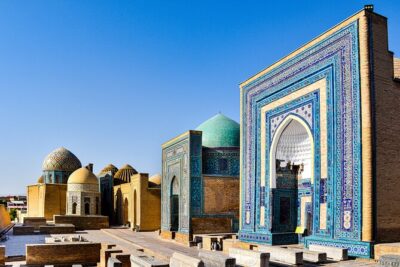
Browse the lists this tour appears in