
Reviewed · ARAL SEA TOURS
Aral Sea Tour from Nukus 1 night / 2 days
The Aral Sea tour takes you to one of Central Asia’s starkest sights: a former inland sea now spread across salt, sand, and rusting ship hulls. You will travel by air-conditioned 4×4 from Nukus, visit Muynak’s ship cemetery, and spend the night beside the dried sea in a yurt.
I like the mix of history and raw desert scenery, especially the Mizdakhan mausoleums and the huge white cliffs of the Ustyurt Plateau. I also like that this is a private trip for up to four people, so you are not being pushed through the stops in a large bus. The catch is the road: expect a long, very bumpy ride, with roughly seven hours going out and eight hours returning.
Key points
- The old seabed is the main event: Walk across the dry floor of the Aral Sea, touch the salt and mud, and see how far the water has retreated.
- Muynak adds human scale: Its ship cemetery and ecological museum show the disaster through the story of a once-busy fishing town.
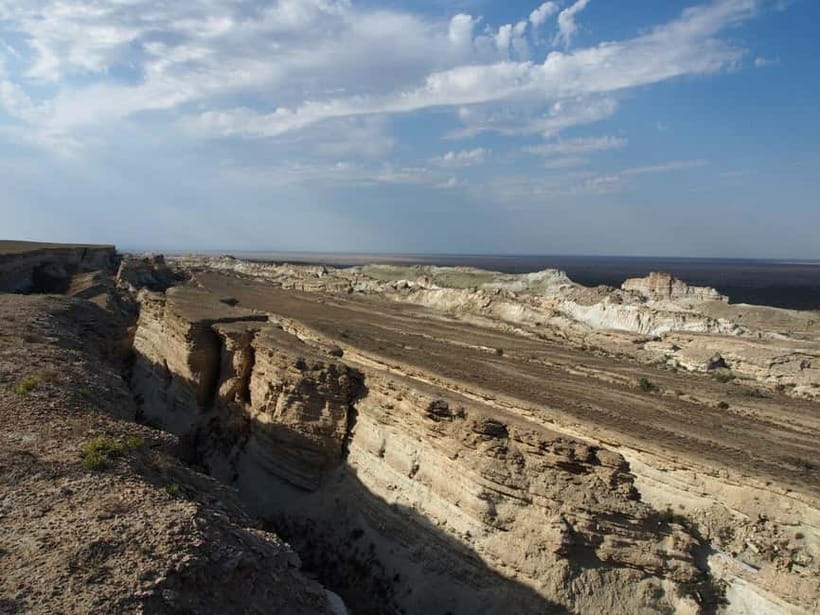
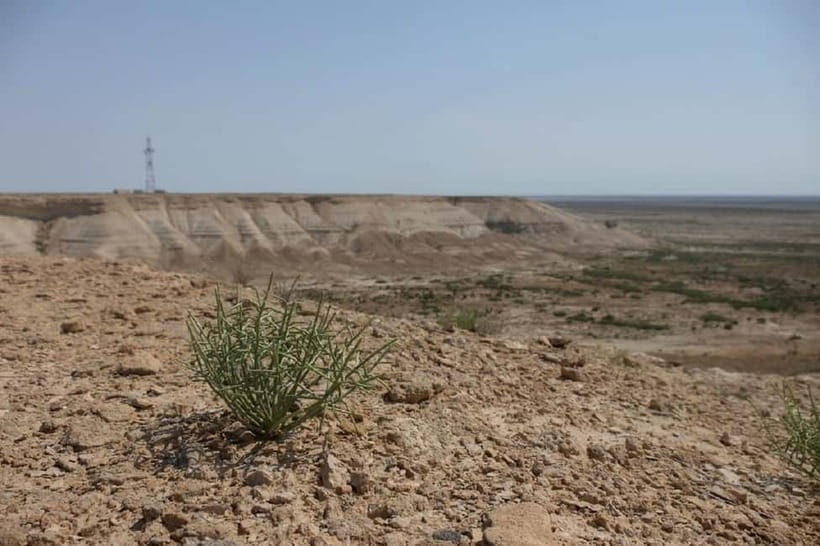
- The Ustyurt Plateau is enormous: White-edged canyons, open desert, and isolated nomad cemeteries make this the most dramatic part of the drive.
- The yurt camp is simple but useful: You get a bed, a campfire setting, electric power, a fresh shower, and a clear night sky, but no mobile or internet connection.
- The cost is not all-inclusive: The base price is $590 per private group of up to four, with the yurt, meals, and museum entry charged separately.
- Your back matters: Bad roads and long hours in a 4×4 make this a poor choice if you have spinal or mobility problems.
Why the Aral Sea still matters
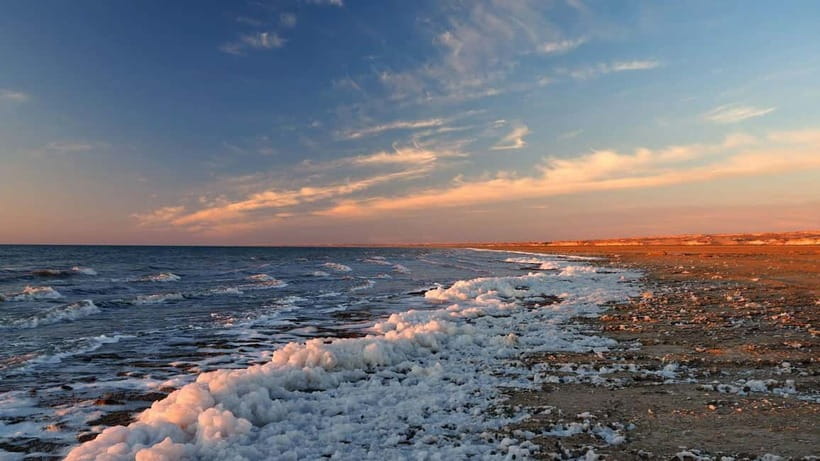
The Aral Sea was once one of the world’s largest inland bodies of water. Water diversion for irrigation caused it to shrink dramatically, leaving fishing ports stranded far from the shore and turning much of the seabed into desert.
That change is not presented here as a tidy museum lesson. You drive across the former sea itself. At the dried seabed, you can walk, touch the ground, and see the dust and salt that replaced open water. It is a powerful reminder that environmental damage is not an abstract topic. It changes towns, jobs, food, weather, and daily life.
The trip is best understood as a long field visit rather than a polished sightseeing excursion. The distances are large, the roads can be rough, and the sights are spread widely apart. In return, you get a part of Uzbekistan that few short city tours can reach.
A few more Uzbekistan days to weigh up
- 2 Days Tour to Bukhara and Samarkand from Tashkent by train
★ 5.0 · 53 reviews - Fergana – Golden Valley From Tashkent 1 night / 2 days
★ 4.5 · 41 reviews - Yurt stay and Hiking in the Nurata Mountains tour – 2 days
★ 5.0 · 35 reviews
What the $590 actually covers
The price is $590 per private group of up to four people, not $590 per person. That makes the basic rate reasonable for a small group, especially when split four ways. It includes an air-conditioned 4×4 vehicle, the driver, pickup, and all stated fees and taxes.
Several important costs are extra:
- One night in the yurt camp: $25 per person
- Four meals, listed as one breakfast, two lunches, and one dinner: $50
- Aral Sea Museum entry: $5 per person
- Personal expenses
The meal price should be clarified when you book, since the information lists $50 for the four meals but does not make completely clear how that amount is calculated. The final amount will be higher than the headline price. One useful budget check is to ask for the full total for your exact group size before departure.
You can be picked up at your Nukus hotel, airport, or railway station and returned to a hotel, airport, or railway station. The tour is private, and the driver speaks English or Russian according to the booking information. One past booking also arranged a separate Nukus to Khiva transfer, so it is worth asking if you need a similar add-on.
Day one begins with Mizdakhan
The first drive from Nukus to the yurt camp covers about 400 kilometers and takes around seven hours with stops. This is not a quick transfer. You will spend much of the day in the vehicle, so bring water for stops, wear loose clothes, and expect the 4×4 to shake and bounce over poor roads.
The first major stop is the Mizdakhan complex, sometimes called the City of the Dead. The site contains a large group of mausoleums and preserves customs connected with the pre-Islamic period. It gives the day an early historical anchor before the route moves into more open country.
Mizdakhan is worth taking slowly. Look at the different shapes and ages of the tomb structures, and pay attention to how the complex sits within the dry setting. This is not a place for a rushed photo stop. It is one of the few points on the route where the human past feels close and visible.
Muynak and the ships left behind
The road continues toward Kungrad and then Muynak. Lunch is recommended around this part of the journey, and the local food may include beef, lamb, fish, rice, wheat or sorghum dough, and vegetables. If you want vegetarian food, tell the operator before the trip.
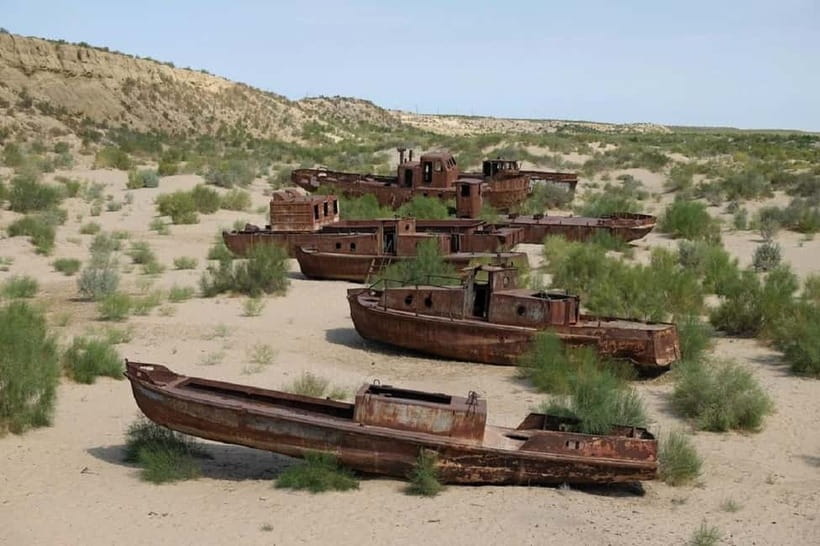
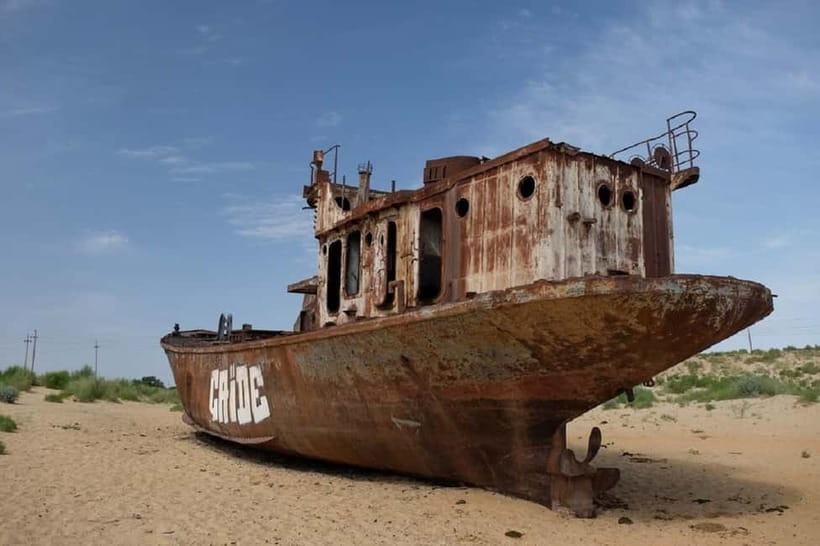
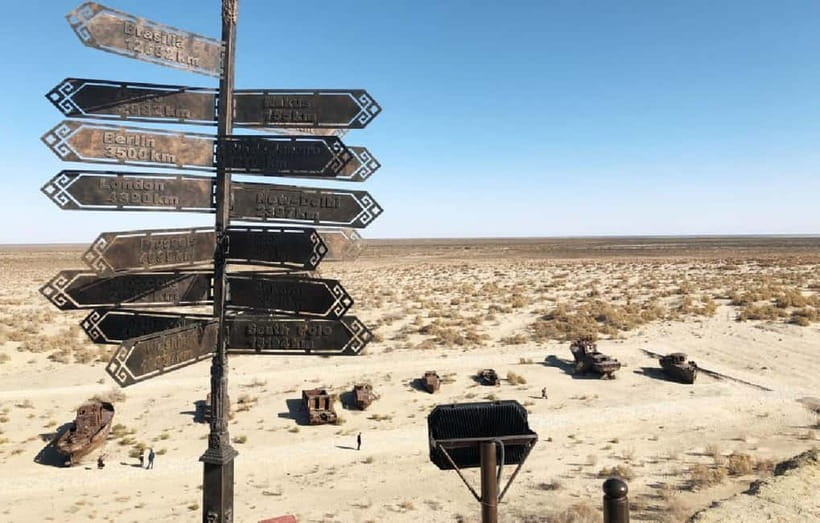
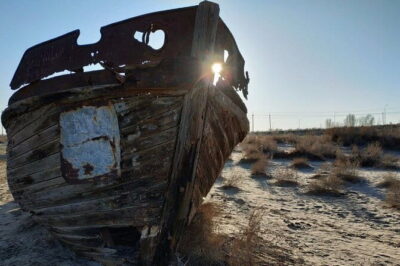
Muynak was once a fishing port on the Aral Sea. Today, the water has retreated many kilometers away, leaving ships stranded on dry ground. At the ship cemetery, rusted hulls sit in the desert like oversized museum pieces. The scene is memorable because the boats have not been placed there for display. They were left behind when the shoreline disappeared.
You will also visit the Aral Sea Ecological Museum of Muynak. The museum provides useful context for the ship cemetery and the wider environmental crisis. The entry ticket is not included in the base cost and is listed at $5 per person.
Muynak is also a good place to understand the limits of this trip. The ship cemetery is visually striking, but it is not a large attraction with a long sequence of exhibits. The value lies in standing there and connecting the abandoned boats with the vanished fishing economy.
More Multi-Day Tours in Uzbekistan:
- Uzbekistan 6 days private tour Tas-Khiva-Buk-Sam-Tas
★ 5.0 · 45 reviews - Uzbekistan 8 Days Private Tour Tashkent-Urgench-Bukhara-Samarkand-Tashkent
★ 4.5 · 38 reviews - From Khiva To Aral Sea 2-Days One Night In Yurt Stay
★ 4.6 · 20 reviews - 7-Day Uzbekistan with the Local: From Blue Domes to Mountains
★ 5.0 · 17 reviews
Crossing the dried seabed
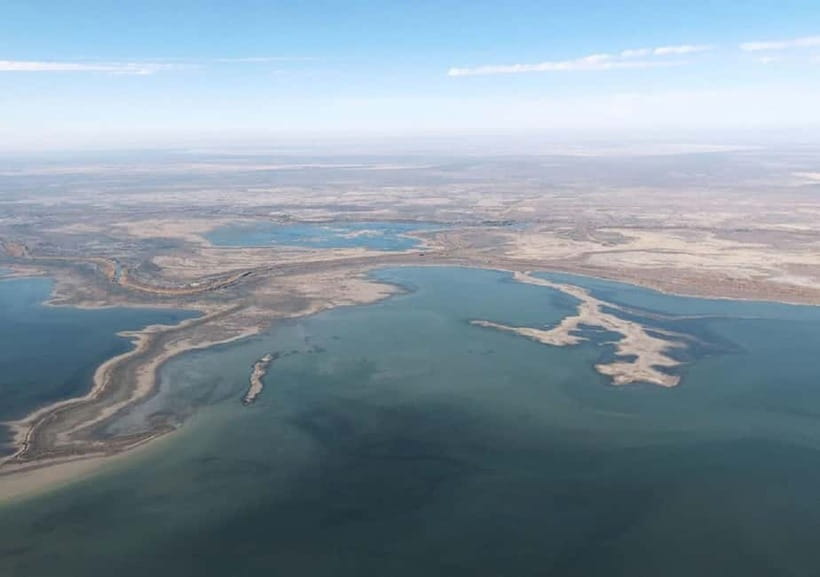
After Muynak, the route passes through Uchsay village and reaches the old seabed. This is where the tour becomes most physical. You can walk across the former sea floor, feel the salt and mud, and see open desert where water once spread across the horizon.
Wear sturdy sport shoes or hiking boots and long trousers. A cap, sunglasses, and sunscreen are practical in the exposed desert. The sun can be strong, and there is little shade. You should also follow the driver’s advice about where to walk, since conditions on the seabed can vary.
The description says swimming is possible at the camp area, and the sea is considered safe for swimming. Pack a swimsuit if you want that option. A fresh shower is available afterward, which matters when salt and mud are part of the day.
The drive to the water area is one of the roughest parts of the route. One booking described the road as full of potholes, while another praised the 4×4 as well suited to the conditions. Both points can be true. The vehicle is appropriate for the road, but an appropriate vehicle does not make the road smooth.
A night at the Aral Sea yurt camp
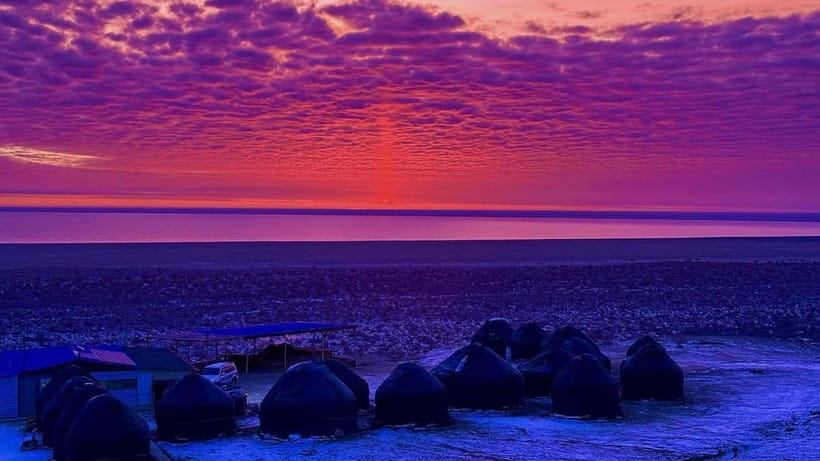
The yurt camp is the practical center of the overnight portion. Accommodation costs extra, at $25 per person, and meals are also separate. The camp provides electric power for charging devices, a telephone for local communication, and a fresh shower.
Do not expect a connected resort. There is no mobile or internet service at the camp. For many people, that is part of the point. You have a chance to stop checking messages and pay attention to the empty horizon, the campfire, and the sky.
At night, the clear conditions can reveal the Milky Way. The campfire offers a simple social setting after a long day on the road. The accommodation is best for people who can accept basic facilities in exchange for being close to the old sea.
Bring warm clothes even if the afternoon is hot. Early spring and late autumn can be cold, and desert temperatures can change quickly after sunset. A warm jacket is specifically recommended for those seasons.
Ustyurt Plateau and its white canyons
The route also crosses the Ustyurt Plateau, a broad, remote area with white-edged canyon formations. The plateau gives you some of the most striking views of the trip. Its scale is difficult to judge from photographs, because the open ground, cliffs, and sky seem to continue without a clear end.
The route may also pass several cemeteries connected with local nomadic communities. These stops are not presented as large formal monuments. Their value is in seeing how people lived and were remembered in a place with few roads and little modern infrastructure.
The Ustyurt portion also explains why the trip takes so long. You are not visiting a single attraction outside Nukus. You are crossing a large region with scattered points of interest, and the road conditions control the schedule more than any sightseeing timetable.
If you enjoy wide desert views, unusual geology, and quiet places, this part may be your favorite. If you dislike long vehicle journeys, it may feel like a lot of time for a small number of stops.
Day two: Kurgancha kala and Sudochie Lake
After breakfast, the return journey takes about eight hours and covers another 400 kilometers. The first stop is the abandoned Davlatgirey caravanserai, also known as Kurgancha kala.
A caravanserai was a stopping place for people moving goods across long trade routes. Here, the remains are abandoned, which gives the stop a quiet, isolated feeling. It works well as a short visit on the way back, especially after the open desert around the camp.
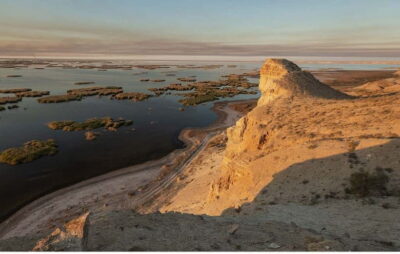
The route then returns across the Ustyurt Plateau before reaching Sudochie Lake. The lake is an important stop for migrating birds, including pink flamingos, white swans, ducks, and other species. Bird sightings depend on conditions and timing, so you should treat them as a possibility rather than a guarantee.
Sudochie Lake adds variety to the trip. After the salt flats, canyons, and dry seabed, a wetland offers a different kind of desert environment. The information also notes that the lake is popular with hunters, so the setting is not simply a protected wildlife viewing area.
Lunch is recommended as a picnic around Kungrad. Since food is not included, confirm the arrangements in advance and tell the operator about any dietary needs.
The road is part of the experience
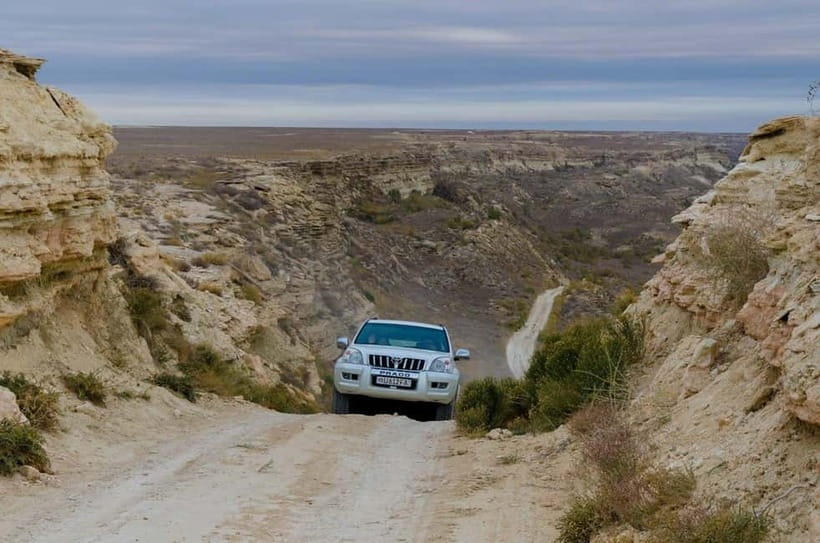
The road deserves its own warning. This is a rough, long-distance desert trip, not a smooth excursion with regular paved highways. The journey out takes around seven hours, and the return takes around eight. The roads can be full of potholes, producing a very bumpy ride.
I would not book this tour if you have back pain, spinal problems, or limited mobility. The experience is also unsuitable for people with mobility impairments, and several stops involve walking on uneven ground.
For everyone else, preparation makes a big difference. Use supportive shoes, keep your sunglasses and hat close, and pack warm layers as well as sun protection. Drinks and food are not allowed in the vehicle, so ask how and when refreshment stops will be handled before setting off.
The private format helps. You are traveling with your own group of up to four rather than sharing a large coach. That gives you more control over short stops and makes the hard hours easier to manage, although the schedule still depends on the road.
What kind of guide service to expect
The tour provides a driver who speaks English or Russian. The role may be more focused on transport and local assistance than on extended guiding at every site, so ask in advance how much explanation you want at Mizdakhan, Muynak, and the plateau.
There was one reported case in which the driver did not speak English despite an English-speaking guide being expected. Because of that, confirm the language arrangement before departure, especially if detailed interpretation matters to you.
The vehicle is a major part of the service. A 4×4 with air conditioning is essential for the distance and road conditions. A skilled and friendly driver can make a real difference on this route, particularly when the track becomes rough and the stops are far apart.
Who should book this Aral Sea tour?
You should consider booking if you want a private, unusual trip from Nukus and are comfortable giving up comfort for access. The experience suits people interested in environmental change, Soviet-era industrial history, desert geology, old trade routes, and remote travel.
It also works well for a small group that can divide the $590 base cost. The extra yurt and meal charges are modest on their own, but they change the final budget. Add the museum ticket and personal expenses, and the total will be noticeably higher than the advertised group rate.
I would skip it if you want short drives, polished facilities, reliable phone service, or a relaxed sightseeing pace. I would also skip it if you have back or mobility problems. The trip is memorable precisely because it reaches a difficult, remote place, and reaching that place takes time and physical tolerance.
Should you book it?
Book this Aral Sea tour if the idea of walking on a vanished sea feels worth a long, rough journey. The ship cemetery, dried seabed, Ustyurt cliffs, and quiet yurt night give you a direct connection to a major environmental disaster.
Before paying, confirm the driver’s language, the exact meal cost, and the full price for your group. Pack for sun, cold, mud, salt, and potholes. If you can handle those conditions, the tour offers a rare and meaningful look at Karakalpakstan that is difficult to reproduce on a shorter outing.
FAQ
How long does the Aral Sea tour take?
The activity lasts 1.5 days, with one overnight stay in a yurt camp. The drive from Nukus to the camp takes about seven hours, and the return drive takes about eight hours.
Where can I be picked up?
Pickup is available from your Nukus hotel, airport, or railway station. Return is available to a hotel, airport, or railway station in Nukus.
Is the tour private?
Yes. It is organized as a private group tour for up to four people.
Is accommodation included in the $590 price?
No. One night in the yurt camp costs an additional $25 per person.
Are meals included?
No. Meals are listed separately as four meals: one breakfast, two lunches, and one dinner, at a stated cost of $50. Confirm the exact calculation when booking.
Is the Aral Sea Museum ticket included?
No. Entry to the Aral Sea Museum in Muynak costs $5 per person.
Will I have phone or internet service at the yurt camp?
There is no mobile or internet connection at the camp. A telephone is available for local communication in the car and at the camp, and electric power is available for charging devices.
What should I bring?
Bring comfortable or protective shoes, long trousers, warm clothing, sunglasses, a sun hat, sunscreen, and comfortable clothes. Swimwear is useful if you plan to swim at the camp area.
Just added around Uzbekistan
- Uzbekistan Tour – 6 Days 5 Nights★ 5.0 · 4 reviews
- Uzbekistan 6 Days Private Tour Khiva-Bukhara-Samarkand by Train★ 5.0 · 4 reviews
- Traditional Khiva Cooking Class with Market Visit & Lunch★ 5.0 · 4 reviews
- Private Intercity Transfer Tashkent – Samarkand – Tashkent★ 3.5 · 3 reviews
- Tashkent-Samarkand-Bukhara tour-3nights/4 days★ 5.0 · 5 reviews
- Tashkent Mountain Tour Amirsoy with Transport★ 3.5 · 3 reviews
- Tashkent City Tour with Hotel Pickup and Drop off★ 4.5 · 4 reviews
- Private Tashkent City Tour★ 5.0 · 3 reviews
Aral Sea Tours, compared.
Daytrip from Khiva to Aral Sea Cemetery of Ships. All in one
Read our review →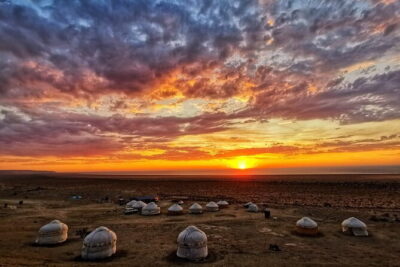
Daytrip From Khiva to Aral Sea Cemetery Of Ships . All In One
Read our review →
Daytrip From Khiva to Savitsky Museum & Mizdakhan & Chilpik
Read our review →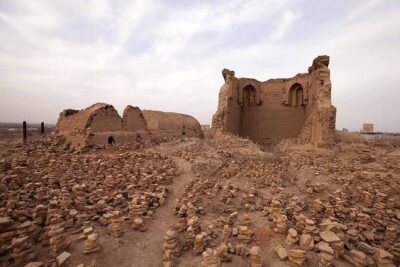
Browse the lists this tour appears in